The Proposal: How to Pitch an Essay Before You Write It
From a text and a hunch to a title, a thesis, and a plan an instructor can approve
- Desk
- The Study Herald Style Desk
- Context
- Contemporary academic writing
- Method
- Proposal, opening paragraph, research plan, working bibliography
- Core Problem
- A proposal must be specific enough to be approved and open enough to allow discovery.
I. The Executive Dispatch (TL;DR)
- A proposal is a pitch, not a miniature essay. It argues for an argument: this is the text, this is the problem, this is what I claim, and this is how I will test it.
- It must prove four things: the project is arguable, specific, feasible, and worth doing. A proposal that fails any one of these is not ready for approval.
- The opening paragraph moves from situation to complication to question to thesis. The reader should be able to underline the thesis and say what you will analyse.
- A thesis is a statement, not a question. The research question asks; the thesis answers. A proposal that ends with a question has not yet made a claim.
- The title is a two-part promise. A distinctive first half catches attention; an informative subtitle tells the reader the text, topic, and angle.
- The plan and bibliography are evidence of feasibility. They show that the project can be finished, not merely that it can be imagined.
- The one-line takeaway: write the proposal you would need to receive if you were the instructor deciding whether to approve the project.
II. What a Proposal Is For
The proposal as a genre
An essay proposal is a short document that asks for approval, feedback, or permission. Its audience is an instructor or supervisor who knows the field and has probably read the text. It is not a contract, and it is not a promise that the final essay will look exactly like the plan. It is a hypothesis with a schedule: a claim worth testing and a route for testing it.
The genre has its own rhetoric. A proposal persuades without pretending to have finished the argument. It demonstrates that the writer can see the problem, name the stakes, and design a method. It is also a thinking tool. Many students discover that their idea is not yet arguable only when they try to write it as a proposal. That discovery is the proposal doing its job.
The four tests
| Test | The question | The failure mode |
|---|---|---|
| Arguable | Is there a claim a reasonable reader could dispute? | A topic summary with no position. |
| Specific | Does it name the text, the passages, and the method? | An essay about “society” or “human nature.” |
| Feasible | Can it be completed in the time and word count available? | Three novels, two languages, and a week. |
| Significant | Why does the argument matter? | A thesis that is true but obvious. |
The tests are not independent. A project can be arguable but not feasible, or feasible but not significant. The proposal is where you find the balance before the deadline finds it for you.
The one-paragraph proposal
Some courses ask for a full proposal with sections, a timeline, and an annotated bibliography. Others ask for something much shorter: a heading, a title, and a single paragraph that pitches the whole project. The one-paragraph format is a compression exercise. Every sentence has to do a job.
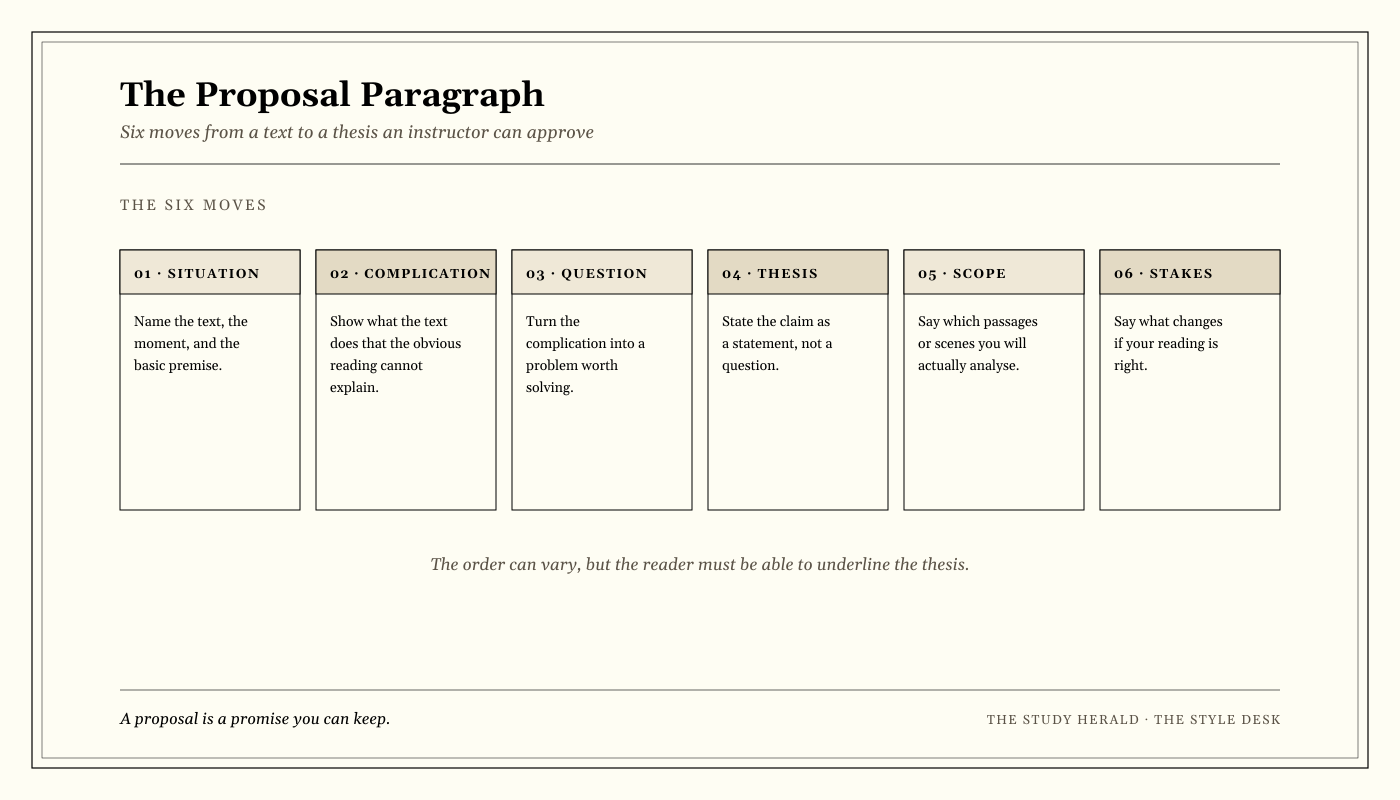
In that format, the paragraph usually carries the entire burden of the pitch:
- It establishes the text and the basic situation.
- It identifies the complication that makes the obvious reading insufficient.
- It turns the complication into a question.
- It states the thesis as a claim.
- It indicates the evidence and the scope.
- It says why the argument matters.
The rest of this guide treats those six moves in detail, because they are the same moves a longer proposal expands. If you can write the paragraph, you can write the proposal. If you cannot, the longer document will only hide the problem in more headings.
Proposal versus essay
A proposal and an essay share a thesis, but they do different work with it.
| Proposal | Essay | |
|---|---|---|
| Purpose | Pitch and plan the argument | Make and defend the argument |
| Audience | Instructor or supervisor | A reader who needs persuading |
| Tense | Future for your plan; present for the text | Present or past, depending on the claim |
| Certainty | Provisional but confident | Defended by evidence |
| Evidence | Indicates the evidence to come | Presents and interprets the evidence |
| Ending | A plan and a stake | A conclusion |
| Length | Short | Long |
The proposal’s thesis is a promise; the essay’s thesis is a conclusion. Both must be contestable. The difference is that the proposal has not yet earned the conclusion, and should not pretend otherwise.
The proposal as hypothesis
A good proposal is specific enough to be approved and open enough to allow discovery. That sounds like a contradiction, but it is the genre’s central discipline. You need a claim strong enough to guide research and a mind open enough to revise the claim when the evidence disagrees.
This is why proposals often include a sentence such as “I expect to find” or “the argument will test whether.” The hedge is not weakness; it is an accurate description of the project at this stage. What a proposal should not say is “I will see what I find.” That is not a hypothesis; it is a postponement.
III. The Opening Paragraph: Six Moves
The opening paragraph of a proposal is not an introduction in the usual sense. It does not need a hook, a panoramic survey, or a throat-clearing paragraph about how important the topic has always been. It needs to get from a text to a thesis efficiently, and it needs to make the reader believe that the thesis is worth the journey.
Move 1: Situation
Name the text, author, date, genre, and the basic premise. Assume an educated reader who has not read the text, but do not assume ignorance. Give only the plot that the argument needs. A proposal is not a book report; the reader does not need the whole story, only the situation that makes the problem visible.
A useful situation sentence answers three questions: What is this text? What does it do? How is it usually read? For example: “Charlotte Perkins Gilman’s ‘The Yellow Wallpaper’ (1892) confines its narrator to a nursery and forbids her to write, and it is usually read as an indictment of the rest cure.” That is enough. The reader knows the text, the premise, and the critical commonplace.
Move 2: Complication
The complication is the turn. It is the point at which the obvious reading stops being sufficient. Use a transition — but, however, yet, although — to make the turn visible, and then name the feature of the text that creates the problem: a contradiction, a pattern, an omission, a formal oddity, a historical tension, or a disagreement among critics.
The complication is not the same as a complication in the plot. It is a complication in the reading. “The story is about a woman who goes mad” is plot. “The story is also about reading: the narrator does not simply endure the wallpaper; she interprets it” is a complication. The second sentence gives the essay somewhere to go.
Move 3: Question
The question is the engine of the essay. It should be narrower than “What does the text mean?” and wider than the thesis. It should be answerable by the evidence you can actually gather, and it should be non-obvious enough that a reader wants the answer.
In a one-paragraph proposal, the question may be implied rather than stated in interrogative form. But the reader should be able to hear it. If the complication is “the narrator interprets the wallpaper,” the question might be: What does her interpretation do to her, and what does the story do with the act of interpretation? That question is specific, answerable, and not merely a request for a theme.
Move 4: Thesis
The thesis answers the question in a declarative sentence. It should be contestable, specific, and mechanism-bearing: not only what you argue, but how or why the text supports it. “I argue that the wallpaper functions as a figure for interpretation itself” is a thesis. “I will discuss the symbolism of the wallpaper” is a topic.
The proposal may use “I argue,” “this essay argues,” or a direct claim without a framing phrase. Any of these can work. What matters is that the sentence could be disagreed with. If no reasonable reader could dispute it, it is not a thesis; it is a truism.
Move 5: Scope
Scope is the promise about what the essay will actually analyse. Name the passages, scenes, chapters, or cases. Say what you will not cover, if the boundary is important. Scope is not a limitation on ambition; it is what makes ambition credible.
“I will read the successive descriptions of the wallpaper alongside the final scene” is scope. “I will analyse the whole story” is a wish. The reader should be able to see the shape of the essay from the scope sentence: which evidence, in what order, for what purpose.
Move 6: Stakes
The stakes answer the “so what?” question. What changes if your reading is right? Does it challenge a critical commonplace, revise a historical assumption, explain a formal feature that has been dismissed, or connect two texts that are usually kept apart? The stakes do not need to be world-historical. They need to be real.
“The argument challenges the habit of treating the wallpaper as a transparent symbol” is a stake. It tells the reader that the essay is intervening in a conversation, not just adding another reading to the pile.
The order can vary
The six moves are a checklist, not a straitjacket. Some proposals begin with the complication, some begin with the question, and some begin with the thesis and then explain how they arrived at it. The order can vary as long as the logic is clear.
What should not vary is the destination. By the end of the paragraph, the reader should be able to restate your thesis in one sentence and say what you will analyse to support it. If they cannot, the paragraph has not finished its job.
The diagnostic
Read your paragraph and mark it up:
- Underline the thesis. If you cannot find one sentence that states the claim, you do not have a thesis yet.
- Circle the evidence. If no passage, scene, or case is named, the scope is too vague.
- Bracket the stakes. If nothing in the paragraph says why the argument matters, the reader has no reason to approve it.
- Draw an arrow at the turn. If there is no but, however, yet, or although, the paragraph may be a list of observations rather than an argument.
IV. The Title and the Thesis
The two-part title
A strong proposal title often has two parts, separated by a colon. The first part is distinctive and evocative; the second part is informative and precise. The first half makes the project memorable; the second half tells the reader what the project is about.
A useful formula is:
[Distinctive phrase or idea]: [Text, topic, and angle]
For example: “The Pattern and the Prison: Interpretation and Confinement in Charlotte Perkins Gilman’s ‘The Yellow Wallpaper’.” The first half is thematic; the second half names the text and the critical problem. A reader who sees only the title knows what the essay will argue about.
Avoid titles that are only a quotation, only a topic, or only a joke. A quotation can be evocative, but it does not tell the reader what you will do with it. A topic is a label, not a promise. A joke may be memorable, but the subtitle still has to do the cataloguing.
The thesis as a promise
A proposal thesis should pass six tests:
| Test | Question | Weak example | Stronger example |
|---|---|---|---|
| Answerable | Can the essay answer it with the evidence available? | “What is the meaning of the wallpaper?” | “What does the narrator’s reading of the wallpaper do to her?” |
| Arguable | Could a reasonable reader disagree? | “The story is about confinement.” | “The wallpaper models interpretation, not merely confinement.” |
| Specific | Does it name a text, mechanism, or pattern? | “Gilman uses symbolism.” | “The wallpaper’s pattern turns reading into a form of confinement.” |
| Mechanism | Does it say how or why? | “The ending is ambiguous.” | “The ending’s ambiguity is produced by the narrator’s shift from observer to participant.” |
| Scope | Does it imply which evidence you will use? | “The story’s imagery.” | “The successive descriptions of the wallpaper and the final scene.” |
| Significant | Does it say why it matters? | “This is an important theme.” | “It challenges the critical habit of reading the wallpaper as a transparent symbol.” |
The table is not a machine for generating theses. It is a diagnostic: if a row fails, the thesis is probably not ready.
Question versus thesis
A research question and a thesis are not the same thing. The question is what you ask; the thesis is what you claim. A proposal can include both, and often should: the question shows the problem, and the thesis shows your answer so far. But the paragraph should end with the claim, not the question.
“What does the wallpaper symbolize?” is a question. “The wallpaper symbolizes patriarchal confinement” is a thesis, but it is a thin one, because it is the obvious answer. “The wallpaper functions as a figure for interpretation, and the narrator’s attempt to decode it reproduces the logic of her confinement” is a thesis with a mechanism and a stake. It could be wrong, which is what makes it worth arguing.
Confidence and provisionality
Proposal prose should sound like a writer who knows what the project is and is honest about what it has not yet proved. Use verbs that commit: argue, contend, show, test, trace. Avoid verbs that retreat: feel, think, maybe, sort of. Hedging should be about evidence, not nerve.
Compare:
- Too vague: “I think the wallpaper might represent something about confinement.”
- Too certain: “The wallpaper proves that the story is about patriarchal oppression.”
- Proposal-ready: “I argue that the wallpaper functions as a figure for interpretation, and I will test that claim against the narrator’s successive descriptions and the final scene.”
The third sentence is confident about the claim and specific about the test. It does not pretend that the argument is finished.
Title, thesis, and plan alignment
The title, thesis, and plan are three versions of the same promise. The title promises a topic and an angle; the thesis promises a claim; the plan promises the evidence and the order. If the title says “interpretation” and the thesis says “symbolism,” or if the thesis promises three texts and the plan discusses one, the reader will distrust the project. Alignment is not decoration; it is evidence that you have thought the project through.
V. The Rest of the Proposal
Format and presentation
If your course uses MLA, the proposal usually carries the same four-line heading as an essay — your name, instructor, course, date — followed by a centred title and double-spaced text. Use page numbers if required. Do not add a cover page unless the assignment asks for one.
Formatting is not the argument, but it is part of the pitch. A clean, consistent document signals that you can follow a style guide and present work professionally. A proposal with inconsistent spacing, a missing title, or a bibliography in the wrong style makes the reader work harder to trust the project.
The research question and rationale
State the research question in one or two sentences, then explain why it is worth asking. The rationale should situate the question in a conversation: a critical debate, a historical problem, a theoretical puzzle, or a gap in the existing accounts. You do not need a full literature review, but you do need to show that you know the conversation exists.
A useful rationale answers three questions: What has been said? What has been missed? Why does this essay need to be written now? The answers do not have to be dramatic. A small, precise intervention is more credible than a grand claim to overturn the field.
Methodology
Methodology is the answer to “how will you know?” It is not a list of fashionable approaches. It is a description of what you will do with the text and why that procedure will produce evidence for your claim.
- Close reading: which passages, which formal features, which patterns?
- Historical contextualisation: which contexts, which sources, which dates?
- Comparison: which texts, which terms of comparison, which differences matter?
- Theoretical framing: which concepts, which limits, which objections?
- Archival research: which archives, which documents, which access?
- Quantitative or computational analysis: which corpus, which method, which validation?
“I will use close reading” is a label. “I will trace the narrator’s shifting descriptions of the wallpaper and compare them with the story’s final scene” is a method. The reader should be able to imagine you doing it.
Scope and structure
A proposal often includes a section-by-section plan. This is a map, not a straitjacket. Give each section a job: establish the problem, develop the first part of the claim, test it against counterevidence, deepen the argument, conclude. If the proposal requires a word count or a timeline, make it realistic.
The structure should follow the argument, not the plot. An essay that moves through the text chronologically may be fine, but the proposal should explain why that order serves the claim. A section plan that says “introduction, body, conclusion” says nothing. A plan that says “first, the critical commonplace; second, the wallpaper as a scene of reading; third, the ending’s collapse of observer and participant” says something.
Sources and working bibliography
A working bibliography is evidence of feasibility. It shows that the primary text is available, that the secondary field exists, and that you know which sources are central. It is not a display of how many books you can list.
Separate primary and secondary sources. Annotate three to five key sources if the assignment asks for it, explaining briefly what each one contributes and where you disagree. Do not pad the bibliography with sources you have not opened. A short, precise list is more convincing than a long, decorative one.
Feasibility
The proposal should acknowledge the practical conditions of the project: access to texts, time, language competence, ethics approval, archival permissions, software, and data. If the project requires human subjects, say how you will handle consent and anonymity. If it requires an archive, say when you will visit or whether the material is digitised. If it requires a corpus, say how you will build and validate it.
Feasibility is not a boring administrative detail. It is part of the argument that the project can be completed. A brilliant proposal that cannot be finished is not a good proposal; it is a fantasy with a bibliography.
The proposal’s style
Proposal prose should be concise, signposted, confident, and specific. Use headings if the format allows. Keep paragraphs short. Use the present tense for what the text does and the future tense for what you will do. Define any jargon you cannot avoid. The proposal is a genre with its own rhetoric: it persuades without pretending to have finished.
VI. Common Failures and How to Fix Them
| Failure | What it looks like | The fix |
|---|---|---|
| The topic proposal | “I will write about symbolism in the story.” | Turn the topic into a question, then answer it with a thesis. |
| The plot summary | Two paragraphs retelling the story. | Cut to the complication; keep only the plot the argument needs. |
| The question-only proposal | Ends with “What does the wallpaper mean?” | Answer the question with a declarative thesis. |
| The survey | “I will explore three themes across four texts.” | Narrow to one claim and one set of evidence. |
| The truism | “The story shows that society is complex.” | Make a claim a reasonable reader could dispute. |
| The method label | “I will use close reading.” | Say which passages and which features you will read. |
| The bibliography dump | Twenty sources with no relation to the argument. | Select, annotate, and explain what each source does. |
| The overpromise | Three novels, two languages, ten weeks. | Scope down to what can be finished well. |
| The mini-essay | A thousand words of argument before the plan. | Cut to the pitch; save the argument for the essay. |
| The false certainty | No counterevidence, no limits, no uncertainty. | Name the strongest objection and say how you will test it. |
The “so what?” test
Ask why the argument matters. If the answer is “because the text is important,” you have not answered the question. The stakes should be specific: a critical assumption, an interpretive habit, a historical narrative, a theoretical blind spot. A proposal without stakes is a plan without a reason.
The “can I finish this?” test
Estimate the time honestly. Reading, note-taking, drafting, revising, and formatting all take longer than they look. A project that requires ten sources, three close readings, and a theoretical frame may be feasible in twelve weeks; a project that requires all of that plus archival travel may not. Scope is not a moral failure. It is a condition of good work.
The “would I approve this?” test
Imagine you are the instructor. You have thirty proposals to read. Does this one tell you what the essay will argue, why it matters, and how it will be done? Can you see the shape of the final essay? If you cannot, neither can the instructor. Revise until you can.
VII. A Model Proposal Paragraph
Here is a model paragraph for a one-paragraph proposal. It uses a different text and argument from any sample you may have seen; the point is the structure, not the content.
Charlotte Perkins Gilman’s “The Yellow Wallpaper” (1892) confines its narrator to a nursery and forbids her to write, and it is usually read as a Gothic indictment of the rest cure. The story certainly supports that reading: the narrator’s journal is secret, her husband is a physician, and the wallpaper’s pattern becomes an object of obsession. Yet the narration also makes the wallpaper a problem of interpretation. The narrator does not simply suffer the pattern; she reads it, assigns it a meaning, and eventually identifies with the woman she believes is trapped behind it. The story’s horror is not only that she is confined but that her reading of the confinement becomes the instrument of her collapse. I argue that the wallpaper functions less as a symbol of patriarchal confinement than as a figure for interpretation itself: the narrator’s compulsion to decode the pattern reproduces the very logic that has confined her, and the ending leaves the reader uncertain whether she has escaped or completed her submission. To test this claim, I will read the successive descriptions of the wallpaper alongside the narrator’s shifting account of the figure behind it and the story’s final scene, where she creeps over her husband. The argument matters because it challenges the critical habit of treating the wallpaper as a transparent symbol and asks instead what the story does with the act of reading.
What the paragraph is doing
- Situation. It names the text, date, premise, and the critical commonplace in two sentences.
- Complication. “Yet the narration also makes the wallpaper a problem of interpretation” turns from plot to reading.
- Question. The question is implicit: what does the narrator’s interpretation do, and what does the story do with interpretation?
- Thesis. “I argue that the wallpaper functions less as a symbol … than as a figure for interpretation itself” is declarative, contestable, and mechanism-bearing.
- Scope. It names the successive descriptions, the figure behind the pattern, and the final scene.
- Stakes. It challenges the habit of treating the wallpaper as a transparent symbol.
What the paragraph avoids
It avoids a full plot summary. It avoids a list of devices. It avoids ending with a question. It avoids the vague claim that the story “explores” or “comments on” confinement. It gives the reader enough plot to understand the problem and no more.
A weak version, for contrast
“The Yellow Wallpaper” is a story about a woman who goes mad. I will discuss the symbolism of the wallpaper and use close reading to show how it represents confinement and patriarchal society.
This is not a proposal; it is a topic with a method label. It does not identify a complication, state a contestable thesis, name a passage, or explain why the argument matters. The revision is not a matter of adding fancier words. It is a matter of finding a problem the essay can solve.
VIII. The Proposal Checklist
Before you submit, check every item:
- Title: distinctive first half, informative subtitle, text and angle visible.
- Heading: correct name, instructor, course, and date; consistent style.
- Situation: text, author, date, genre, and premise are accurate.
- Complication: a clear turn, marked by a transition, that makes the obvious reading insufficient.
- Question: specific, answerable, and narrower than the topic.
- Thesis: declarative, contestable, mechanism-bearing, and scoped.
- Scope: passages, scenes, chapters, or cases are named.
- Stakes: the “so what?” is answered in specific terms.
- Method: what you will do, not just the name of an approach.
- Structure: a section plan that follows the argument, not the plot.
- Sources: primary and secondary sources selected and, if required, annotated.
- Feasibility: time, access, ethics, and materials are realistic.
- Read-aloud test: a reader can restate your thesis in one sentence after hearing the paragraph once.
If you can tick all thirteen, you have a proposal. If you can tick only the first twelve, you have a document that looks like a proposal. The read-aloud test is the one that matters most.
IX. Exam & Essay Sparkplugs
1. “A proposal should be specific enough to be approved and open enough to allow discovery.” Discuss.
Winning Thesis Blueprint. A proposal needs a claim strong enough to guide research and a method flexible enough to register what the research finds. The tension is productive: specificity makes the project credible, while provisionality makes it honest.
Supporting points.
- The four tests: arguable, specific, feasible, significant.
- The difference between a working thesis and a final thesis.
- The role of counterevidence in a proposal’s plan.
2. “A thesis is a promise; a proposal is a plan to keep it.” Discuss with reference to your own writing process.
Winning Thesis Blueprint. The thesis commits the essay to a claim, and the proposal commits the writer to a route of evidence and inquiry. A proposal that cannot be revised is not rigorous; a thesis that never changes is probably not being tested.
Supporting points.
- The six moves of the proposal paragraph.
- The alignment of title, thesis, scope, and structure.
- The difference between a change of plan and a change of subject.
3. Write a one-paragraph proposal for a text you know, then annotate its six moves.
Winning Thesis Blueprint. A strong answer will produce a paragraph with a clear situation, a genuine complication, an answerable question, a contestable thesis, a specific scope, and a stake. The annotation should explain what each sentence is doing, not merely label it.
Supporting points.
- The diagnostic: underline the thesis, circle the evidence, bracket the stakes.
- The read-aloud test.
- One revision that makes the paragraph more specific.
The proposal is not the essay’s first draft. It is the essay’s first argument — about what the essay will be.