Judith: The Sword, the Saint, and the Severed Head
Female heroism, divine violence, and the Anglo-Saxon rewriting of a biblical book
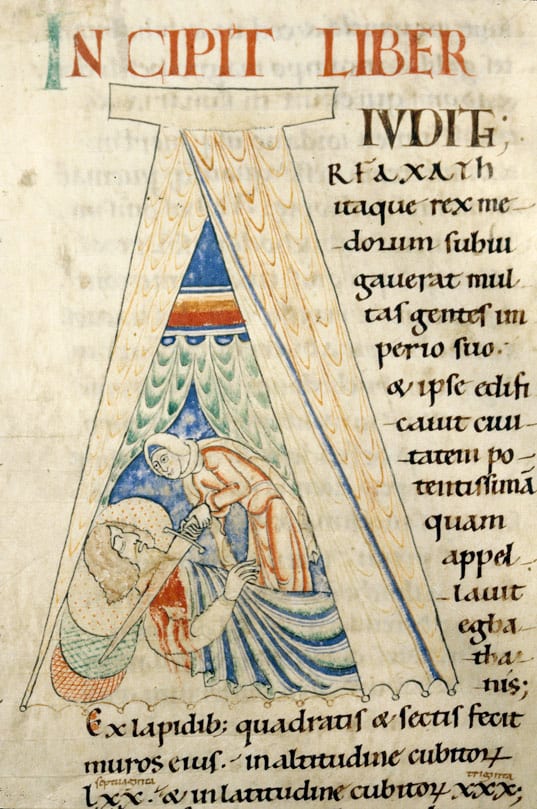
- Author / Source
- Anonymous Old English poet (Cynewulfian school)
- Period
- Late tenth to early eleventh century (c. 975–1025)
- Form & Meter
- Old English alliterative verse; 349 surviving lines
- Core Conflict
- How can a woman’s clandestine killing be celebrated as heroic virtue in a warrior culture that identifies heroism with male public combat?
I. The Executive Dispatch (TL;DR)
- Judith is a biblical story rewritten as a Germanic heroic poem. The Latin Book of Judith supplies the plot; the Old English poet supplies the mead-hall, the battle vocabulary, and the monstrous feast.
- The poem’s heroine is a warrior, but not a man. Judith is called a “holy woman” and a “wise woman,” yet she acts with a sword, commands troops, and displays a severed head. The poem does not resolve the contradiction; it makes it the source of her power.
- The beheading is a two-stroke action, not a clean symbol. The first blow fails; the second severs the head. That detail matters: the poem insists on the physical difficulty of what Judith does.
- The manuscript context is part of the meaning. Judith survives beside Beowulf in the Nowell Codex, a collection obsessed with monsters, pride, and the fragile boundary between hero and monster.
- The one-line exam takeaway: Judith turns a private act of violence into a public sign of national deliverance — and asks what kind of heroism a woman is allowed to perform.
II. Historical & Intellectual Context (“The Backstory”)
The manuscript and the missing frame
Judith survives in a single manuscript, the Nowell Codex, copied around 975–1025 and now part of British Library Cotton Vitellius A.xv. The codex also contains Beowulf, The Wonders of the East, the Letter of Alexander to Aristotle, and the Life of St Christopher. Judith follows Beowulf at the end of the manuscript and was copied by Scribe B, one of the two scribes responsible for Beowulf.
The poem is incomplete. Its opening is lost, and the surviving text begins in the middle of the narrative, with Holofernes’ feast already underway. The ending may also be lost, though the surviving lines reach the rout of the Assyrians. Modern editions print 349 lines. The missing frame matters: we cannot know how the poet introduced Judith, how much of the biblical backstory was included, or how the poem originally concluded. Any interpretation has to work with a text that begins in medias res and ends at the edge of victory.
The biblical source and the Anglo-Saxon present
The ultimate source is the Latin Vulgate Book of Judith, an apocryphal book accepted in the Catholic and Orthodox traditions but rejected by Protestant Bibles. The story is simple: Holofernes, an Assyrian general, besieges the Israelite city of Bethulia. Judith, a pious widow, enters the enemy camp, seduces Holofernes with her beauty, gets him drunk, and beheads him. The Israelites rout the leaderless Assyrians.
The Old English poet changes the story’s political and social texture. The Vulgate emphasizes the religious leadership of priests and elders; the Old English poem turns Bethulia into something closer to a Germanic war-band. Judith becomes a public leader who exhorts her people to battle. Holofernes becomes a feast-lord whose hall is a parodic inversion of the heroic mead-hall: he drinks, boasts, and orders his men to bring Judith to his bed. The poem’s world is not ancient Assyria so much as an imagined heroic past refracted through Anglo-Saxon anxieties.
Those anxieties were real. The late tenth and early eleventh centuries saw renewed Viking attacks on England, monastic reform, and intense debate about the moral condition of the kingdom. Ælfric of Eynsham wrote a prose homily on Judith and explicitly offered her as an example to the English: the story was to encourage them to defend their land with weapons against an attacking force. The Old English poem belongs to the same cultural moment. Judith is not merely a biblical heroine; she is a model of resistance to a monstrous invader.
Authorship and the Cynewulfian style
The author is unknown. Earlier scholars proposed Cynewulf, whose signed poems (Elene, Juliana, The Fates of the Apostles, Christ II) share Judith’s hagiographic interests and a taste for heroic saintly women. There is no runic signature in Judith, and the attribution is no longer widely accepted. It is safer to say that the poem belongs to the Cynewulfian school: it shares the school’s diction, its interest in female sanctity, and its habit of fusing heroic and religious vocabulary.
That fusion is the poem’s signature. Judith is not a saint who rejects the warrior code; she is a saint who uses it. The poem calls her a “holy woman” and a “wise woman,” but it also gives her the language of a battle-leader. The result is a text in which sanctity and violence are not opposites but collaborators.
III. Structural & Formal Architecture
The alliterative line
Judith is written in the traditional Old English alliterative metre: unrhymed long lines, each divided by a caesura into two half-lines, with four stressed syllables and alliteration binding the halves together. The metre is flexible, but its effect is incantatory. It is the same metre as Beowulf, and the poem exploits that association: Judith sounds like heroic poetry even when it is describing a woman sneaking out of a tent with a severed head.
Alliteration often carries the emotional weight. When the poet describes Judith as halige meowle (56), “holy woman,” the phrase is simple, but it sits inside a poem that keeps yoking holiness to violence. The alliterative form allows the poet to move quickly between prayer and action, between the language of the psalter and the language of the battlefield.
Variation, kennings, and heroic diction
Old English poetry builds meaning through variation: a person or object is named repeatedly through synonyms and epithets. Judith is a halige meowle (holy woman), a snoteran idese (wise woman, 55), and aelfscinu (elf-shining, 13). Each term pulls her in a different direction: saint, counsellor, and something stranger and more luminous. The poem’s heroine is never just one thing.
The poet also uses the heroic vocabulary of the war-band. Holofernes is a feast-lord, a giver of rings, a commander; his hall is a place of drinking and boasting. The irony is that this heroic world is shown in decline. Holofernes’ feast is not a model of comitatus loyalty but a scene of drunken excess. The poem uses heroic conventions to critique a heroic culture that cannot recognize its own monstrousness.
The shape of the surviving poem
The text falls into four broad movements, though the lost opening means the boundaries are editorial rather than authorial:
| Movement | What happens | Interpretive pressure |
|---|---|---|
| The feast | Holofernes celebrates, drinks, and orders Judith brought to him | The mead-hall becomes a site of predatory appetite |
| The prayer | Judith prays for strength and takes up the sword | Divine authorization for female violence |
| The beheading | Two blows; the head is hidden and carried back to Bethulia | The poem dwells on physical effort and concealment |
| The display and battle | Judith shows the head; the Israelites attack; the Assyrians flee | Private act becomes public military sign |
The structure is not a simple rise-and-fall plot. It is a sequence of translations: Judith moves from the city to the enemy camp, from prayer to action, from private chamber to public assembly, and from a hidden weapon to a displayed head. Each translation changes the meaning of what she has done.
IV. The Chronicle: Section-by-Section Breakdown
The Feast of Holofernes
The Action. The surviving poem opens with Holofernes’ army feasting. Holofernes is drunk and boastful. He orders his men to bring Judith to his tent so that he can lie with her. The poem presents the feast as an inversion of the heroic mead-hall: instead of generosity and loyalty, there is appetite, excess, and the abuse of power.
Key Evidence. The poem’s opening is lost, but the surviving feast is saturated with the language of heroic celebration turned sour. Holofernes is a rinc and a lord, but his hall is a place of medo and win where judgment collapses. The narrator’s contempt is audible in the way the Assyrians are described as a drunken multitude rather than a disciplined army.
The Subtext. The feast establishes the poem’s moral geography. Holofernes is not merely an enemy; he is a monstrous host who abuses the obligations of hospitality. His hall is a parody of the comitatus, the war-band bound by gifts and loyalty. The poem is already telling us that the heroic code can be corrupted from within.
Judith’s Prayer and Resolve
The Action. Judith prays to God for victory. She asks for strength, courage, and the ability to carry out her plan. The poem emphasizes her wisdom and her faith. Then she takes Holofernes’ sword and approaches the bed.
Key Evidence.
“…halige meowle…” (56) and “…snoteran idese…” (55)
The two epithets are placed close together: holiness and wisdom. Judith is not a berserker; she is a woman who thinks, prays, and then acts. The poem’s heroism is as much strategic as physical.
The Subtext. Judith’s prayer is the poem’s theological hinge. It transforms what would otherwise be a story of deception and murder into a story of divine judgment. But the prayer does not make the violence clean; it makes it authorized. The poem is interested in the difference between authorization and innocence.
The Beheading
The Action. Judith strikes Holofernes with his own sword. The first blow does not sever the head; she strikes again, and the head comes away. She hides it in a bag and leaves the camp with her maid.
Key Evidence. The poem describes the blow with the concentrated physicality of heroic verse: the sword, the neck, the bone, the blood. The two-stroke action is crucial. A single miraculous blow would make Judith a wonder-worker; two blows make her a worker. The poem wants us to feel the effort.
The Subtext. The beheading is both a military act and a symbolic one. Holofernes’ head represents the enemy’s power; once it is separated from the body, the Assyrian army loses its capacity to act. The poem also plays on the decapitation motif that runs through the Beowulf manuscript: heads, monsters, and the boundary between the human and the monstrous. Judith’s act is heroic, but it is also unsettlingly intimate. She kills a man in his bed, with his own weapon, while he is drunk.
The Display and the Rout
The Action. Judith returns to Bethulia and displays the head to the Israelites. She urges them to attack. The Israelites arm themselves and fall upon the Assyrians. The enemy camp discovers Holofernes’ headless body and panics. The poem breaks off as the rout begins.
Key Evidence. The head is the poem’s central image. It is carried, hidden, displayed, and interpreted. Judith does not simply kill Holofernes; she turns his death into a text that her people can read. The display is a political act: it converts a private killing into a public sign of divine favor.
The Subtext. The poem’s ending, even in its fragmentary state, is about interpretation. The Israelites must understand what the head means before they can act. The Assyrians, by contrast, are undone by what they see. The poem is fascinated by the power of visible evidence — and by the fragility of a community that depends on a symbol to hold together.
V. The Editorial Board: Deep Thematic & Critical Analysis
The woman warrior and the limits of gender inversion. Judith is repeatedly described in terms that elevate her above ordinary women: holy, wise, elf-shining. Yet the poem never lets her become a man. She does not fight in the battle; she enables it. Her authority is real, but it is authorized by God and ratified by the male elders of Bethulia. The poem’s gender politics are therefore double-edged: it celebrates a woman’s power while containing it within a theological and communal frame.
Chastity as weapon. Judith’s sexual purity is central to the story. She enters the enemy camp as a beautiful woman, but she does not consummate anything. Holofernes’ desire is the trap; Judith’s chastity is the power that allows her to spring it. Medieval readers often interpreted Judith as a type of the Church or the Virgin Mary: the woman who preserves her purity and destroys the enemy of God. The poem does not spell out the allegory, but it leaves the typological door open.
Monstrous excess and the heroic hall. Holofernes is not a complex psychological villain; he is a figure of excess. He drinks too much, boasts too much, and desires too much. The poem contrasts his chaotic feast with Judith’s disciplined prayer. The heroic hall, which should be the site of community and generosity, becomes a place of predation. This is a familiar move in Old English poetry: the mead-hall is always vulnerable to the monster outside and the appetite inside.
National deliverance and the Viking present. The poem’s immediate historical context is probably the Viking wars. Ælfric’s homily explicitly presents Judith as a model for defending the land. The Old English poem amplifies the military dimension: Judith leads, the Israelites fight, and the Assyrians flee. The story becomes a fantasy of national deliverance in which a vulnerable community is saved by a divinely sanctioned act of violence. That fantasy is powerful, but it is also anxious: the enemy is huge, the city is besieged, and the deliverance depends on a woman’s secret courage.
The manuscript’s monsters. Judith’s placement after Beowulf invites comparison. Both poems feature a monstrous enemy, a hall under threat, and a hero who must confront a creature that embodies excess. But Judith reverses the pattern: the monster is human, the hero is a woman, and the weapon is a sword taken from the enemy. The codex as a whole is a meditation on the fragile border between the heroic and the monstrous.
VI. Exam & Essay Sparkplugs
1. “Judith is a hero in a poem that does not know what to do with female heroism.” Discuss.
Winning Thesis Blueprint. The poem celebrates Judith’s courage while repeatedly containing it within masculine and theological frameworks: she is holy, wise, and divinely authorized rather than simply strong. A strong essay can argue that the poem’s tension between admiration and containment is precisely what makes Judith a complex hero.
Supporting points.
- The epithets
halige meowleandsnoteran ideseand their combination of sanctity and wisdom. - Judith’s prayer as the source of her authority and the limit of her agency.
- The transfer of military action to the male Israelites after the display of the head.
2. “The beheading is the poem’s central interpretive problem.” Examine the significance of the two-stroke killing.
Winning Thesis Blueprint. The two strokes insist on the physical and moral effort of Judith’s act, preventing the reader from treating the beheading as a clean allegory. The poem wants us to see both the divine authorization and the human violence, and the doubled blow holds them together.
Supporting points.
- The contrast between a single miraculous blow and the poem’s emphasis on labour.
- The intimacy of the killing: a man in bed, his own sword, a woman’s hand.
- The head as a public sign that must be interpreted by the community.
3. “Judith is a political poem before it is a devotional one.” How far do you agree?
Winning Thesis Blueprint. The poem’s religious language is inseparable from its vision of national survival: Judith’s victory is both a divine judgment and a military rallying cry. Yet the devotional frame is not merely decorative; it is what makes the violence usable as propaganda.
Supporting points.
- Ælfric’s homily and the Viking context.
- The transformation of Bethulia into a heroic war-band.
- The poem’s ending with the rout of the Assyrians rather than with Judith’s private piety.