The Wife of Bath: Experience, Sovereignty, and the Art of the Prologue
Chaucer’s most talkative pilgrim on marriage, authority, and the loathly lady
- Author / Source
- Geoffrey Chaucer (c. 1343–1400)
- Period
- Late fourteenth century; Canterbury Tales begun c. 1387
- Form & Meter
- Dramatic verse prologue and Arthurian romance in rhyming couplets
- Core Conflict
- Who has the authority to define marriage, desire, and female nature — experience or the clerical book?
I. The Executive Dispatch (TL;DR)
- The Wife of Bath’s Prologue is a performance of authority. She begins by opposing experience to clerical books, then spends hundreds of lines quoting, misquoting, and rewriting those books. Her authority is not outside the tradition; it is a raid on it.
- The Prologue is about marriage as a power struggle. Five husbands, one surviving, and a long argument about who gets to control property, sex, and speech. The Wife’s apparent frankness is also a tactic.
- The Tale turns the question of desire into a question of rule. A knight must discover what women most desire; the answer is sovereignty. But the Tale’s happy ending depends on a choice that is not entirely free.
- The rape is not an embarrassment to be skipped. It is the Tale’s opening premise, and it shapes everything that follows: the queen’s judgment, the knight’s education, and the hag’s demand for marriage.
- The one-line exam takeaway: The Wife of Bath asks whether a woman can seize sovereignty inside a story written by men — and leaves the answer suspended between comedy, wish-fulfilment, and critique.
II. Historical & Intellectual Context (“The Backstory”)
Chaucer, the pilgrimage, and the frame
Geoffrey Chaucer was a London bureaucrat, courtier, and poet who served in the households of Edward III and Richard II and travelled in France and Italy. The Canterbury Tales was begun in the late 1380s and left unfinished at his death in 1400. Its frame is a pilgrimage from London to the shrine of Thomas Becket at Canterbury. The Host, Harry Bailly, proposes a storytelling contest, and the pilgrims take turns.
The frame is crucial. The Wife of Bath is not a free-standing author; she is a character in a social comedy. Her Prologue is a dramatic monologue delivered to a mixed audience of pilgrims, and her Tale is a performance shaped by that audience. Chaucer gives her a distinctive voice, but he also places that voice in a contest with other voices: the Clerk, the Merchant, the Franklin, and the antifeminist tradition they inherit.
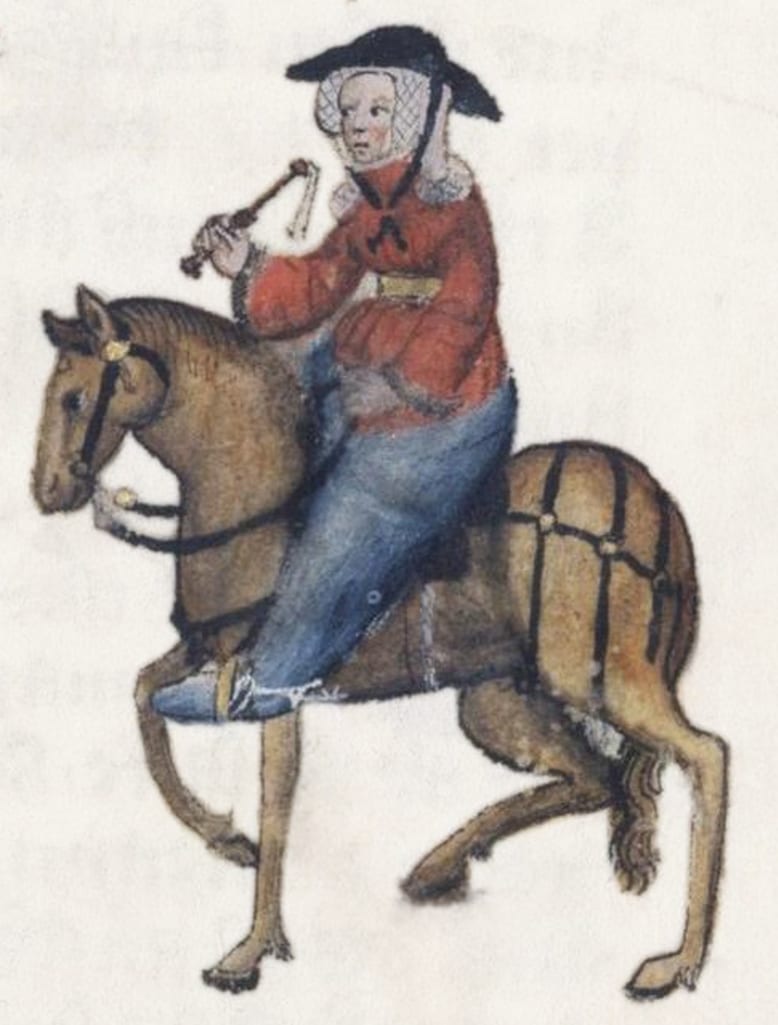
The Wife’s biography is part of her argument. She is a cloth-maker from Bath, a widow, and a veteran of five marriages. She has travelled to Jerusalem, Rome, Boulogne, Santiago, and Cologne. She wears scarlet, spurs, and a hat broad as a buckler. She is economically independent, sexually experienced, and unapologetic. In the estates satire of the General Prologue, she is both a recognizable social type and a deliberate exaggeration.
The antifeminist book and the marriage debate
The Wife’s Prologue is saturated with the antifeminist tradition: St Jerome’s Adversus Jovinianum, Theophrastus on marriage, Walter Map, and the ubiquitous clerical commonplace that women are lustful, disobedient, and impossible to satisfy. She knows this material intimately. She quotes it, parodies it, and turns it against itself.
The Tale draws on the loathly lady motif, familiar from Arthurian romance and from Irish sovereignty tales. John Gower’s Confessio Amantis includes the story of Florent, and there are analogues in Sir Gawain and the Carl of Carlisle. Chaucer’s version is distinctive in its combination of romance, folk-tale, and legalistic debate. The Tale’s answer to the knight’s quest — sovereignty — is also the Prologue’s central demand.
The Canterbury Tales as a whole contains a “marriage group”: the Wife of Bath, the Clerk, the Merchant, and the Franklin all tell tales about marriage, authority, and desire. The Wife’s Prologue sets the terms for that debate. She claims the authority of experience; the Clerk replies with the authority of patient Griselda; the Merchant offers a cynical counterpoint; the Franklin imagines a marriage of mutual “maistrye.” The sequence is not a debate with a single winner. It is a polyphony.
III. Structural & Formal Architecture
The Prologue as dramatic monologue
The Wife’s Prologue is roughly 856 lines, written in rhyming pentameter couplets. It has no single genre: it is confession, sermon, autobiography, legal argument, and gossip. The Wife moves rapidly between registers, quoting scripture, citing her husbands, and addressing her audience directly. The effect is improvisational, but the structure is carefully managed.
The Prologue is organised around a series of marriages and a series of arguments. The Wife begins with experience and authority, then defends multiple marriages, then describes her first three husbands, then her fourth, then her fifth, the clerk Jankyn. The narrative keeps circling back to the same questions: who has the right to rule, who has the right to speak, and who has the right to interpret the book?
The Tale as romance and folk-tale
The Tale is about 408 lines, also in rhyming couplets. It begins in “th’ olde dayes of the kyng Arthour” (WBT 857), a deliberately archaic setting. Its plot is a folk-tale: a knight commits a crime, is given a quest, meets a loathly lady, learns the answer to a riddle, and is rewarded with a transformed bride. The romance frame gives the story a familiar shape; the content keeps disturbing it.
The Tale’s structure is a sequence of judgments. The knight is judged by the queen and her ladies; he is sent out to find an answer; he is judged by the hag’s demand; he is judged again by the choice she offers him. The Tale is less interested in adventure than in the legal and ethical questions that adventure makes possible.
The voices of the Wife
The Wife’s voice is one of Chaucer’s greatest inventions. She is funny, aggressive, self-dramatising, and intellectually agile. She uses rhetorical questions, proverbs, Latin tags, and vivid domestic detail. She can sound like a victim, a bully, a theologian, and a stand-up comic within a few lines.
That versatility is the point. The Wife is not a stable “character” whose opinions can be extracted and paraphrased. She is a performance of the positions available to a medieval woman who wants to speak in public. Her contradictions are not flaws in Chaucer’s characterisation; they are the substance of the satire.
IV. The Chronicle: Section-by-Section Breakdown
The Prologue: Experience Against Authority
The Action. The Wife opens by declaring that experience is enough authority for her, even if there were no books in the world. She defends multiple marriages, argues that virginity is not the only Christian vocation, and insists that her sexual organs were made for both pleasure and procreation. She then begins the account of her five husbands.
Key Evidence.
“Experience, though noon auctoritee / Were in this world, is right ynogh for me…” (WBP 1–2)
The couplet is a manifesto, but it is also a trap. The Wife says she does not need authority, then spends the rest of the Prologue quoting authorities. Her experience is not pure or unmediated; it is already shaped by the books she claims to reject.
“Housbondes at chirche dore I have had fyve…” (WBP 6)
The line is deliberately blunt. The Wife refuses the shame that the antifeminist tradition attaches to remarriage. Her tone is not defensive; it is triumphant.
The Subtext. The Prologue’s opening is a battle over the source of truth. The Wife claims the authority of the body and of lived experience; her opponents claim the authority of scripture and clerical learning. The poem does not simply side with her. It shows that her experience is real, but also that she is entangled in the very discourses she resists.
The Prologue: The Husbands and the Book
The Action. The Wife describes her first three husbands as old, rich, and easily managed. She accuses them of subscribing to antifeminist stereotypes while depending on her for sex and care. She describes her fourth husband, a reveller with a mistress, and her grief at his death. Then she turns to Jankyn, her fifth husband, a young clerk who reads from a “book of wikked wyves.” She tears pages from the book and hits him; he hits her back, and the fight ends in a reconciliation that gives her control of the household.
Key Evidence.
“Who peyntede the leon, tel me who? / By God, if wommen hadde writen stories, / As clerkes han withinne hire oratories…” (WBP 692–94)
The lion parable is the Wife’s sharpest attack on textual authority. The lion looks at a painting of a man killing a lion and asks who painted it. If women had written the stories, the picture would look different. The argument is not that women are naturally innocent; it is that representation is interested.
“He is a fool that…” — the Wife’s account of Jankyn’s book is a catalogue of clerical commonplaces, each one designed to make women seem monstrous.
The Subtext. The marriage to Jankyn is the Prologue’s climax because it turns reading into a domestic struggle. The book is not an abstract authority; it is a weapon in the bedroom. When the Wife tears out pages, she is literally assaulting the textual tradition that has defined her. The fight that follows is ugly and funny at once, and the reconciliation is uneasy: she wins control, but only after violence.
The Tale: The Knight, the Rape, and the Quest
The Action. A knight in Arthur’s court rapes a maiden. The court condemns him to death, but Queen Guinevere and her ladies intervene. They set him a quest: he must discover what women most desire, or he will die. He travels for a year and a day, asking women he meets, but they give contradictory answers. At last he meets an old hag who promises to tell him the answer if he will grant her the next thing she asks. He agrees. She tells him the answer: sovereignty over their husbands and lovers. He returns to court, answers correctly, and is saved. The hag then demands that he marry her.
Key Evidence.
“What thyng is it that wommen moost desiren?” (WBT 905)
The question is deceptively simple. The Tale’s answer will be “sovereignty,” but the poem has already shown that women’s desires are not singular. The knight’s quest assumes that there is one answer, and the hag’s power depends on his need for one.
“Wommen desiren to have sovereynetee / As wel over hir housbond as hir love, / And for to been in maistrie hym above.” (WBT 1038–40)
The answer is a political demand, not a psychological generalization. It says that women want rule — over husbands as well as lovers. The Tale’s happy ending depends on whether the knight can accept that answer as a principle rather than a password.
The Subtext. The rape is the Tale’s founding violence. It establishes the knight’s guilt, the queen’s authority, and the need for an education in desire. Yet the Tale does not dwell on the victim; it moves quickly to the knight’s quest. That rapidity is troubling. The poem asks us to notice what the romance form leaves out: the woman who was assaulted, the social conditions that make her assault possible, and the ease with which the narrative converts her suffering into the knight’s lesson.
The Tale: The Hag’s Speech and the Choice
The Action. The knight marries the hag in private, but he is miserable. On their wedding night, she asks him why he is so sad. He complains that she is old, ugly, and low-born. She replies with a speech on gentillesse: true nobility comes from virtue, not lineage; poverty is not shameful; age brings wisdom. She then offers him a choice: he can have her old and faithful, or young and beautiful, but not both. He submits the choice to her. She becomes young and beautiful and promises to be faithful. They live happily.
Key Evidence. The hag’s speech on gentillesse is one of Chaucer’s most quoted passages. Its argument is that “gentilesse” is a moral quality, not a social rank. The speech is also a lesson in reading: the knight has been judging by appearances, and the hag teaches him to look at what lies beneath.
The choice she offers is not a simple either/or. It is a test of whether the knight can relinquish the power to choose. When he says “I put me in your wyse governaunce” (WBT 1236), he grants her sovereignty. Only then does she become both beautiful and faithful.
The Subtext. The ending is often read as a fantasy of mutual consent, but it is also a fantasy of male surrender. The knight does not become a better person through introspection; he becomes a better person by giving up control. The Tale’s utopia is built on a bargain: the hag gets sovereignty, the knight gets beauty and fidelity, and the reader gets a happy ending. Whether that bargain is just is left open.
V. The Editorial Board: Deep Thematic & Critical Analysis
Experience and authority. The Wife’s opening opposition between experience and authority is not a simple binary. She uses experience to challenge the books, but her experience is shaped by the books she has read and by the social roles she inhabits. The Prologue dramatizes the difficulty of finding a voice outside a tradition that has already described you. The Wife’s solution is not to escape the tradition but to reappropriate it: she quotes, misquotes, and performs the antifeminist text until it becomes a vehicle for her own authority.
Sovereignty and the limits of the Tale. The Tale’s answer — sovereignty — is both a principle and a password. The knight learns the words, but he does not understand them until he submits to the hag’s choice. Even then, the ending is ambiguous: the hag’s transformation is a reward for his surrender, and her beauty restores the conventional romance ending. The Tale gives the woman sovereignty and then makes her beautiful, as if to reassure the reader that female rule and heterosexual desire can be reconciled.
Rape, consent, and the romance form. The Tale begins with a rape and ends with a marriage. The juxtaposition is deliberately uncomfortable. The knight’s quest is supposed to teach him about women’s desires, but the woman he assaulted disappears from the story. The hag’s demand for marriage is a kind of reparation, but it is also another coercive bargain. The Tale’s happy ending does not resolve the ethical problem; it displaces it into the conventions of romance.
Gentillesse and class. The hag’s speech on gentillesse challenges the knight’s assumption that nobility is inherited. True gentility, she argues, is shown in virtue and conduct. The speech is democratic in principle, but it is also conservative: it replaces one hierarchy (birth) with another (moral worth). The Tale does not imagine a world without rank; it imagines a world in which rank is deserved.
The Wife as performer and the problem of irony. The Wife is one of Chaucer’s most vivid characters because she is constantly performing. She addresses her audience, anticipates their objections, and adjusts her story to their reactions. That performance makes it difficult to know when she is sincere and when she is manipulating. Chaucer’s irony is not a key that unlocks the “real” meaning; it is a condition of the text. The Wife is both a critic of misogyny and a participant in it.
VI. Exam & Essay Sparkplugs
1. “The Wife of Bath’s Prologue is a triumph of experience over authority.” Discuss.
Winning Thesis Blueprint. The Prologue stages a rebellion against clerical authority, but it also shows that the Wife’s experience is mediated by the very texts she opposes. Her triumph is rhetorical rather than absolute: she wins the argument by appropriating authority, not by escaping it.
Supporting points.
- The opening couplet’s claim to experience and the subsequent flood of quotations.
- The lion parable as a theory of interested representation.
- The Jankyn episode, where reading and domestic violence collide.
2. “The Tale’s ending resolves nothing.” How far do you agree?
Winning Thesis Blueprint. The Tale’s happy ending is a generic convention that papers over the ethical problems it has raised: the rape, the coercive bargain, and the knight’s superficial education. Yet the ending also offers a genuine fantasy of mutual sovereignty that the Prologue has made us want.
Supporting points.
- The disappearance of the raped maiden from the narrative.
- The hag’s choice and the knight’s submission as the condition of transformation.
- The contrast between the Tale’s romance closure and the Prologue’s unresolved argument.
3. “Chaucer’s Wife of Bath is both a feminist critic and a misogynist caricature.” Discuss.
Winning Thesis Blueprint. The Wife exposes the interests behind antifeminist texts, but she also embodies many of the stereotypes those texts promote: appetite, talkativeness, manipulation, and a desire for mastery. Chaucer’s irony holds both possibilities together, refusing to let the reader settle on a single judgement.
Supporting points.
- The Wife’s self-description as sexually appetitive and economically independent.
- Her manipulation of her first three husbands and her violence against Jankyn.
- The Tale’s movement from rape to romance and its suppression of the victim.