Paradise Lost, Book IV: Eden, Envy, and the First Night
Satan’s soliloquy and the invention of domestic happiness
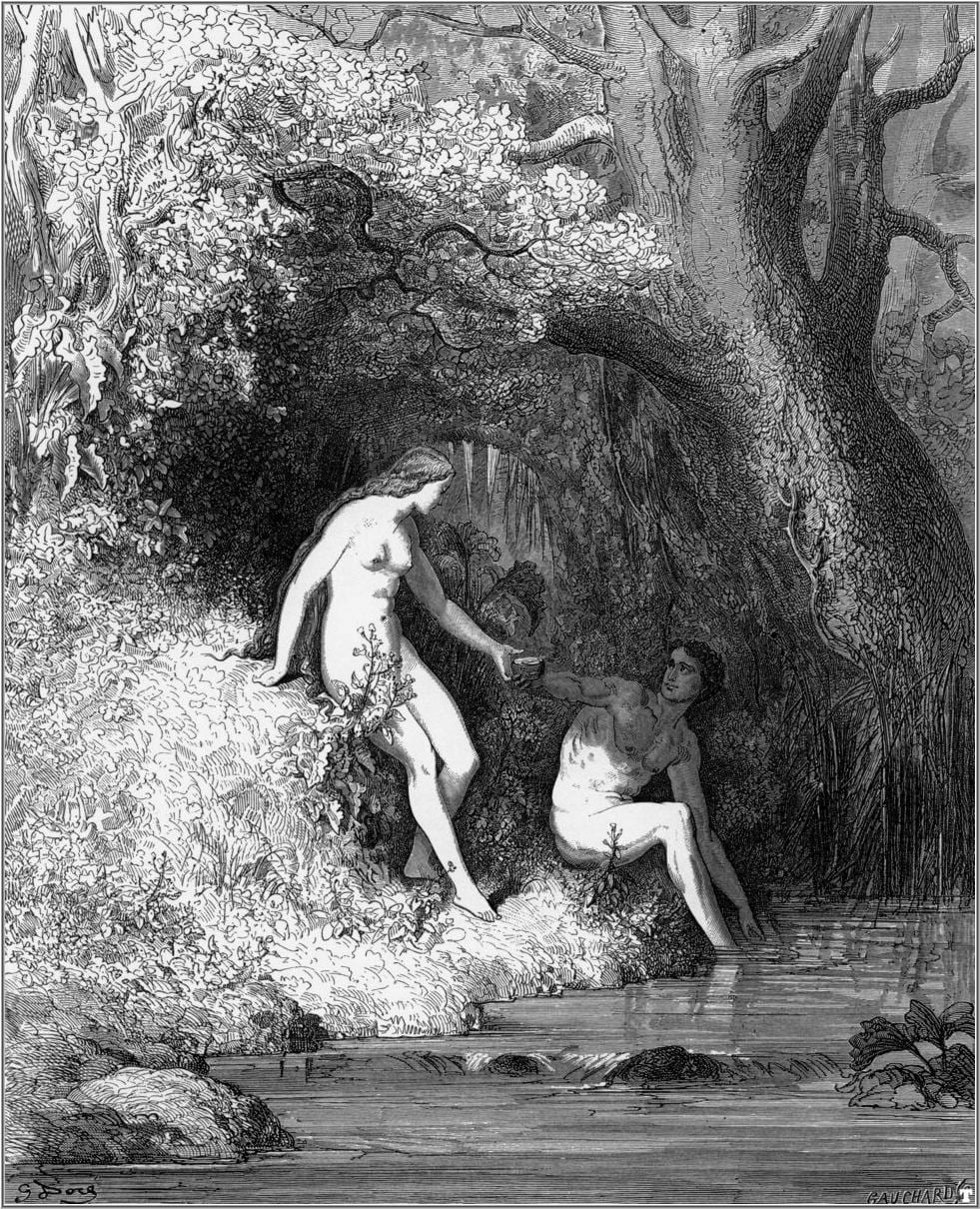
- Author / Source
- John Milton (1608–1674)
- Period
- Restoration England; Paradise Lost, 1667/1674
- Form & Meter
- Pastoral epic, soliloquy, dialogue, and hymnic description in blank verse
- Core Conflict
- Can Eden’s innocent hierarchy survive the envy of a being who has made a Hell within himself?
I. The Executive Dispatch (TL;DR)
- Book IV is the poem’s first sustained image of happiness. Eden is beautiful, fertile, and ordered; it is also the place where Satan’s envy becomes most acute.
- Satan’s soliloquy turns the poem inward. “Which way I fly is Hell; myself am Hell” is the psychological centre of the book and a counterpoint to his heroic rhetoric in Book I.
- Eden’s hierarchy is presented as harmonious but fragile. Adam and Eve are not equals in Milton’s scheme, but their relationship is mutual, affectionate, and dependent on free consent.
- “Hail, wedded Love” is a radical celebration of married sexuality. It stands against Satan’s voyeurism and against the poem’s own ascetic temptations.
- The one-line exam takeaway: Book IV shows that Hell is not only a place but a way of seeing, and that Eden’s beauty is most vulnerable when it is watched by envy.
II. Historical & Intellectual Context (“The Backstory”)
Paradise and the pastoral tradition
Milton’s Eden draws on the pastoral tradition: a garden of delight, gentle work, abundant food, and harmonious companionship. It also draws on biblical imagery: the garden of Genesis, the Song of Songs, and the prophetic visions of a restored creation. The result is a place that feels both mythic and domestic.
Eden is not a wilderness. It is a cultivated garden, and Adam and Eve are gardeners. Work is part of their happiness, not a punishment. Milton’s description of their “pleasant labour” is a rebuke to the idea that manual work is inherently degrading. Eden is a place of purposeful activity, not passive leisure.
Marriage, hierarchy, and mutuality
Milton’s view of marriage was unusual for his time. He argued for divorce on grounds of incompatibility and wrote in defence of companionate marriage. In Paradise Lost, Adam and Eve’s relationship is hierarchical — Adam is the head, Eve is “for God in him” — but it is also described as a union of “one flesh,” a partnership of conversation, work, and delight.
The poem’s hierarchy has been intensely debated. Some readers see it as a patriarchal ideal; others see it as a qualified hierarchy that the poem itself complicates. The strongest readings hold both: Milton presents hierarchy as part of created order, and then shows how Adam’s failure to exercise proper authority, and Eve’s desire for independent knowledge, contribute to the Fall.
Satan’s psychology
Book IV gives Satan his most introspective speech. Alone in the garden, he acknowledges his own misery, his lost happiness, and the impossibility of escape. The soliloquy is a study in self-deception: Satan knows that he is the author of his own Hell, but he cannot repent.
Milton’s portrayal is psychologically modern. Satan is not a simple villain; he is a being who has chosen a version of himself and now cannot imagine another. His envy of Adam and Eve is not just jealousy of their happiness; it is grief for the happiness he has lost.
III. Structural & Formal Architecture
Pastoral description and dramatic contrast
Book IV alternates between description and drama. The long description of Eden is interrupted by Satan’s soliloquy, then resumed through Adam and Eve’s conversation, then broken again by Satan’s intrusion. The structure creates a rhythm of exposure: the reader sees Paradise, then sees it through Satan’s eyes, then sees it again as a home.
The pastoral mode is not naive. Milton’s garden is full of sensory detail, but it is also a place of boundaries, duties, and warnings. The serpent is already present in the poem’s language, even before he appears.
The soliloquy and the inward turn
Satan’s soliloquy is a dramatic monologue addressed to himself, to the sun, and to the reader. It reveals his inner conflict and his refusal to accept responsibility. The syntax is tortured, full of rhetorical questions and self-justifications. The effect is claustrophobic: the more Satan talks, the more trapped he becomes.
Hymn and anti-hymn
The book contains two kinds of lyric: Adam and Eve’s evening prayer, which praises God’s creation, and Satan’s soliloquy, which turns creation into a mirror of his own pain. The contrast is structural. Eden’s worship is outward-looking; Satan’s speech is inward-curving.
IV. The Chronicle: Section-by-Section Breakdown
Satan’s Soliloquy (4.1–130)
The Action. Satan enters Eden and sees the sun. He addresses the sun, recalls his former glory, and admits that he is miserable. He knows that he cannot repent, and he resolves to pursue evil because it is the only course left to him.
Key Evidence.
“O, for that warning voice, which he, who saw / The Apocalypse, heard cry in Heaven aloud…” (4.1–2)
The narrator wishes for a warning voice, but no warning comes. The reader is placed in the position of a watcher who knows what the characters do not.
“Which way I fly is Hell; myself am Hell; / And in the lowest deep a lower deep / Still threatening to devour me opens wide…” (4.75–77)
The line is the psychological centre of the poem. Hell is not just a location; it is Satan’s inward condition.
“Evil, be thou my good.” (4.110)
The phrase is a moral inversion, but it is also a confession. Satan chooses evil knowing it is evil.
The Subtext. Satan’s soliloquy destroys the heroic illusion of Book I. He is not a freedom fighter; he is a prisoner of his own choice. The reader’s sympathy is now mixed with pity and horror.
Eden Described (4.131–287)
The Action. The narrator describes Eden: its walls, streams, trees, flowers, birds, and animals. The garden is abundant, ordered, and alive.
Key Evidence. The description is rich in sensory detail and classical allusion. The “verdurous wall” of Paradise, the “happy rural seat of various view,” and the “birds their quire apply” create a world of harmony.
The Subtext. Eden is a place of plenitude, but its boundaries are also a reminder of limitation. The garden is not the whole world; it is a protected space with a gate.
Satan’s Envy (4.288–355)
The Action. Satan sees Adam and Eve and is struck by their beauty and happiness. He envies them, and his envy turns into a desire to destroy.
Key Evidence.
“Not equal, as their sex not equal seemed; / For contemplation he and valour formed, / For softness she and sweet attractive grace…” (4.296–98)
The description establishes the poem’s gender hierarchy. Adam is associated with contemplation and valour; Eve with softness and grace.
“He for God only, she for God in him.” (4.299)
The line is one of the poem’s most contested statements about marriage and gender. It presents hierarchy as part of created order, but the poem’s later action will show how fragile that order is.
“So hand in hand they passed, the loveliest pair / That ever since in love’s embraces met.” (4.321–22)
The image is tender and mutual. The poem holds hierarchy and companionship together, even when the combination is unstable.
The Subtext. Satan’s envy is not merely sexual or political; it is metaphysical. He cannot bear to see creatures who are lower than he is enjoying a happiness he has forfeited.
Adam and Eve’s Conversation (4.356–775)
The Action. Adam and Eve talk about their life in Eden, their work, their gratitude, and their love. Eve tells the story of her creation; Adam explains their relationship. They pray together and retire to their bower.
Key Evidence.
“My Author and Disposer, what thou bidst / Unargued I obey: So God ordains; / God is thy law, thou mine…” (4.635–37)
Eve’s speech articulates the poem’s hierarchy of authority: God, Adam, Eve. It is also a statement of trust.
“Sweet is the breath of Morn, her rising sweet, / With charm of earliest birds…” (4.641–42)
Eve’s hymn to morning is one of the poem’s most lyrical passages. It expresses gratitude for creation and delight in the senses.
“Hail, wedded Love, mysterious law, true source / Of human offspring, sole propriety / In Paradise of all things common else.” (4.750–52)
Milton’s celebration of married love is radical in its frankness. It insists that sexuality is holy, not shameful.
The Subtext. The conversation establishes the goodness of Eden and the depth of Adam and Eve’s relationship. It also reveals the terms of their obedience: they are free, but their freedom is exercised within a structure of authority.
Satan’s Intrusion and Gabriel’s Guard (4.776–1015)
The Action. Satan enters the garden as a cormorant, then as a toad, and whispers into Eve’s ear. He is discovered by Ithuriel and Zephon, brought before Gabriel, and challenged. Satan boasts, but he is forced to withdraw.
Key Evidence.
“Squat like a toad, close at the ear of Eve…” (4.800)
The image is grotesque and intimate. Satan’s power is not only military; it is the power to whisper.
“Satan, I know thy strength, and thou knowest mine.” (4.1006)
Gabriel’s challenge is calm and authoritative. It shows that evil can be resisted, at least for now.
The Subtext. The first intrusion ends in retreat, but it plants the seed of temptation. Satan has seen the garden and the couple; the next step will be to find a way in.
V. The Editorial Board: Deep Thematic & Critical Analysis
Hell as inward condition. Satan’s “myself am Hell” is the book’s decisive reinterpretation of Hell. In Book I, Hell is a place of fire and darkness; in Book IV, it is a state of mind. The poem does not deny the reality of external punishment, but it shows that sin creates its own inward prison.
Envy and the destruction of the good. Satan’s envy is not motivated by a desire for something Adam and Eve have; it is motivated by the pain of seeing them happy. Envy wants to destroy the good it cannot possess. The poem presents this as a fundamental perversion of love.
Hierarchy and mutuality. Milton’s Eden is hierarchical, but it is not simply oppressive. Adam and Eve work together, converse, pray, and delight in each other. The poem’s later tragedy will show that hierarchy without trust is fragile, and that mutuality without obedience is also fragile.
Married love and the body. “Hail, wedded Love” is a deliberate challenge to ascetic Christianity. Milton presents sexual love as part of Eden’s goodness, not as a consequence of the Fall. Satan’s voyeurism and envy are the distorted counterparts of that love.
The pastoral and its limits. Eden is a pastoral ideal, but it is not a utopia without danger. The garden has a gate, a guard, and a prohibition. The poem’s pastoral is a place of beauty and testing, not escape.
VI. Exam & Essay Sparkplugs
1. “Book IV turns Hell into a state of mind.” Discuss.
Winning Thesis Blueprint. Satan’s “myself am Hell” redefines Hell as an inward condition created by choice, while the poem keeps the external reality of punishment intact. The book’s psychological depth makes evil credible without making it attractive.
Supporting points.
- Satan’s soliloquy and its self-justifications.
- The contrast between Eden’s outward beauty and Satan’s inward torment.
- The narrator’s framing of Satan’s envy.
2. “Milton’s Eden is a patriarchal paradise.” How far do you agree?
Winning Thesis Blueprint. Milton presents Eden as a hierarchy with Adam as head, but he also emphasises mutuality, companionship, and Eve’s dignity. The poem’s tragedy complicates the hierarchy rather than simply endorsing it.
Supporting points.
- “He for God only, she for God in him.”
- Eve’s account of her creation and her trust in Adam.
- Adam’s later uxoriousness and its consequences.
3. “‘Hail, wedded Love’ is the most radical passage in Book IV.” Examine.
Winning Thesis Blueprint. Milton’s celebration of married sexuality challenges ascetic and dualistic attitudes toward the body, presenting desire as part of Eden’s goodness. The passage’s radicalism is heightened by its contrast with Satan’s voyeuristic envy.
Supporting points.
- The language of “mysterious law” and “true source.”
- The contrast between wedded love and Satan’s lust.
- The poem’s later linking of fallen desire and shame.