Paradise Lost, Book II: The Council of Hell and the Road Through Chaos
Deliberation, despair, and the birth of Sin and Death
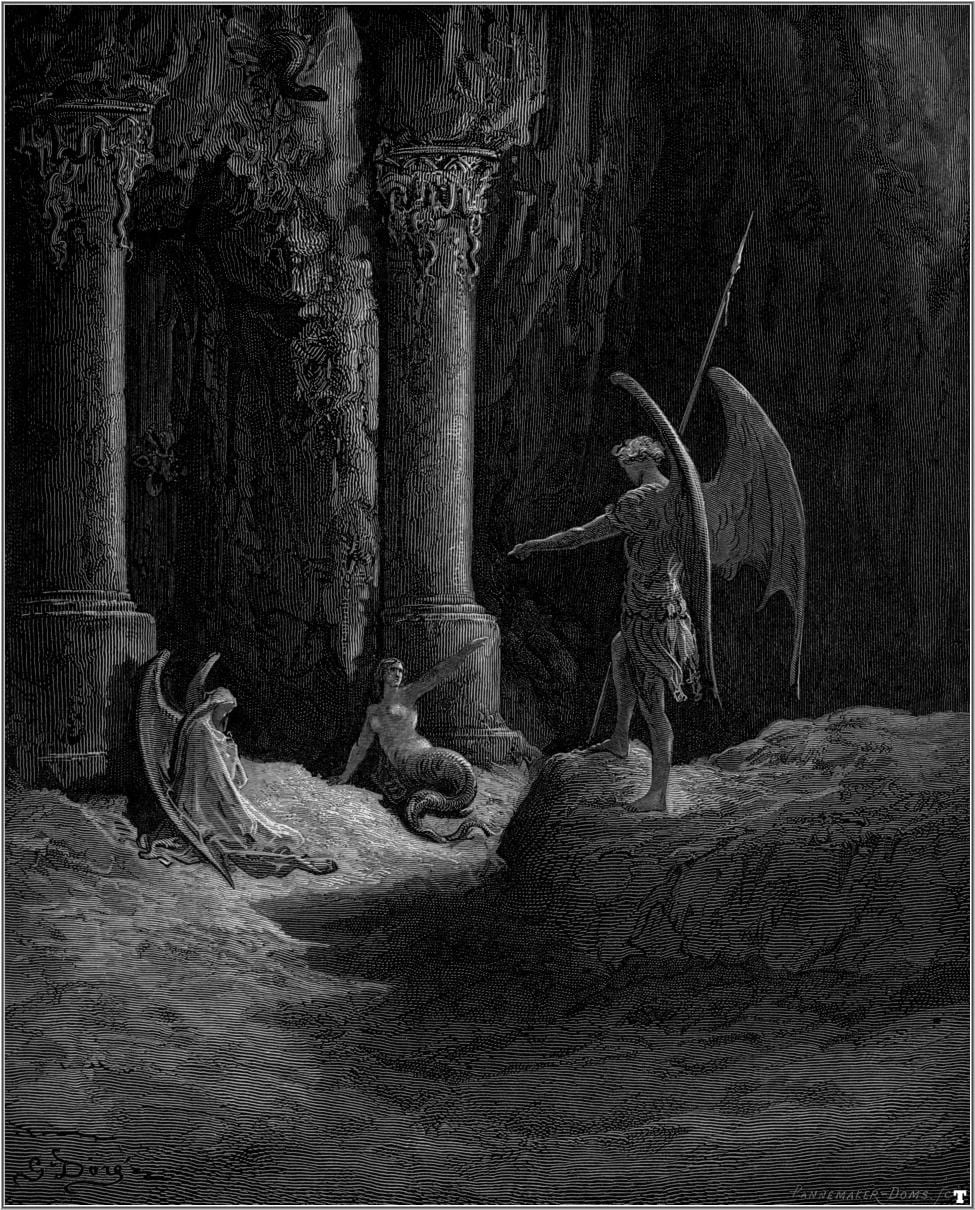
- Author / Source
- John Milton (1608–1674)
- Period
- Restoration England; Paradise Lost, 1667/1674
- Form & Meter
- Epic council and debate; allegorical journey; blank verse
- Core Conflict
- Can a council of the damned deliberate freely, or is its rhetoric only a more elaborate form of bondage?
I. The Executive Dispatch (TL;DR)
- Book II is a council of war that becomes a study of rhetoric. Each speaker embodies a different response to defeat: rage, quietism, accumulation, and guile.
- Moloch’s courage is despair in heroic dress. He would rather be annihilated than endure; his war policy is a demand for meaning through destruction.
- Belial’s eloquence is the most seductive and the most dangerous. He sounds reasonable because he counsels patience, but his patience is merely survival without hope.
- Beelzebub’s proposal wins because it converts revenge into strategy. He suggests a new world and a new target: mankind. The council’s “moderation” is the beginning of the Fall.
- The one-line exam takeaway: Book II shows how deliberation can be managed, how evil reproduces itself, and how a journey through Chaos becomes a journey toward a garden.
II. Historical & Intellectual Context (“The Backstory”)
Milton’s republican imagination
Milton spent the 1650s defending the English Commonwealth and the execution of Charles I. He believed in government by counsel, but he also knew how easily counsel could be corrupted. Book II’s infernal parliament is not a simple attack on parliaments; it is an exploration of what happens when deliberation is severed from justice.
The fallen angels have retained their hierarchical instincts. Satan presides on a throne; the “great Seraphic Lords and Cherubim” sit in “close recess and secret conclave”; the lesser spirits crowd the hall. The council looks like a parliament, but it functions like a court. The outcome is shaped by Satan’s authority and by the desire of the fallen to preserve their sense of greatness.
The epic council tradition
Classical epic is full of councils. In the Iliad, leaders debate war and honour; in the Aeneid, Aeneas’s men deliberate in crisis. Milton draws on these models but gives the council a theological dimension. The fallen angels are not deciding whether to fight a human enemy; they are deciding how to live after rejecting God.
The debate also engages the classical rhetorical tradition. Each speech is a set piece: Moloch’s blunt militancy, Belial’s polished reasonableness, Mammon’s utilitarian calculus, Beelzebub’s strategic synthesis. Milton lets us hear the appeals, then shows how they serve a common refusal to repent.
Sin, Death, and allegory
At the gates of Hell, Satan meets Sin and Death. Sin emerges from Satan’s head, is raped by him, and gives birth to Death; Death then rapes Sin, producing the hounds that torment her. The allegory is grotesque and deliberately overdetermined. It fuses classical myths (Sin as a kind of Medusa or Scylla), biblical language, and seventeenth-century ideas about generation and corruption.
The episode is not an interruption of the plot. It explains the plot’s logic. Evil is not a single act; it is a genealogy. Satan’s rebellion produces Sin, Sin produces Death, and Death becomes the instrument of human ruin. The allegory makes visible what the poem’s narrative will enact.
III. Structural & Formal Architecture
The council as a rhetorical machine
Book II opens with Satan “High on a throne of royal state” (2.1). The image is deliberately imperial: “royal state,” “Ormus and of Ind,” “barbaric pearl and gold.” Satan’s authority is theatrical, but it is also real. The debate that follows is framed by his presence.
The speeches move through a sequence of positions:
- Moloch: open war, total destruction.
- Belial: no war, endurance, wait for change.
- Mammon: build an empire in Hell, abandon Heaven.
- Beelzebub: use guile, find a new world, seduce mankind.
The sequence is not neutral. Each speech answers the previous one, and Beelzebub’s proposal arrives as the “middle” option that can unite the council. The form of debate conceals the fact that Satan has already decided on a mission.
The journey through Chaos
After the council, Satan travels alone through Chaos and Old Night to reach the newly created world. The journey is an epic descent and a parody of heroic quest. Satan passes through unformed matter, negotiates with Chaos, and emerges into the created universe. The journey gives the poem its spatial scale: Hell, Chaos, Heaven, Earth.
Allegory and epic simile
The Sin and Death episode is allegory, but it is also narrated with the vividness of epic. Sin’s body, Death’s shapelessness, the hounds at Sin’s waist — these are visual, grotesque, and memorable. Milton’s similes keep expanding the frame: the council is compared to bees, the fallen angels to locusts, Satan’s journey to the flight of a ship or a vulture. The poem constantly moves between the cosmic and the mundane.
IV. The Chronicle: Section-by-Section Breakdown
Satan’s Opening Speech (2.1–42)
The Action. Satan sits on a throne and addresses the council. He claims that the fall has made the fallen more glorious, that he rules by merit and consent, and that they should debate whether to wage open war or use guile.
Key Evidence.
“High on a throne of royal state, which far / Outshone the wealth of Ormus and of Ind…” (2.1–2)
The comparison to Eastern wealth is double-edged. It elevates Satan’s throne and associates it with luxury, trade, and arbitrary power.
“I give not Heaven for lost: from this descent / Celestial Virtues rising will appear / More glorious and more dread than from no fall…” (2.14–16)
Satan turns catastrophe into a narrative of ascent. The rhetoric is exhilarating; the logic is demonic.
The Subtext. Satan’s speech establishes the terms of the debate. He does not ask whether to repent; he asks how to continue the war. The possibility of submission is excluded from the start.
Moloch: Open War (2.43–105)
The Action. Moloch argues for immediate, total war. He would rather be annihilated than endure Hell. He believes that the fallen can storm Heaven or, at worst, force God to destroy them.
Key Evidence.
“My sentence is for open war. Of wiles, / More unexpert, I boast not…” (2.51–52)
Moloch’s bluntness is almost refreshing after Satan’s rhetoric. But his courage is a form of nihilism: he wants destruction because he cannot imagine a meaningful future.
The Subtext. Moloch represents the temptation to solve despair through violence. His speech shows that heroic language can be a cover for the death drive.
Belial: The Counsel of Ease (2.106–228)
The Action. Belial argues against war. He describes the strength of Heaven’s defences and the misery of annihilation. He suggests that the fallen should endure, wait, and hope that time will soften their punishment.
Key Evidence.
“To be no more. Sad cure! for who would lose, / Though full of pain, this intellectual being…” (2.146–47)
Belial’s fear of oblivion is deeply human. He values consciousness even in suffering.
“Thus Belial, with words clothed in reason’s garb, / Counselled ignoble ease and peaceful sloth, / Not peace…” (2.226–28)
The narrator’s judgement is explicit. Belial’s eloquence is not wisdom; it is accommodation.
The Subtext. Belial is the most seductive speaker because he sounds moderate. He turns paralysis into patience and calls it peace. The poem suggests that the refusal to act can be as culpable as the desire to destroy.
Mammon: An Empire in Hell (2.229–309)
The Action. Mammon rejects both war and submission. He proposes that the fallen build their own kingdom in Hell, exploiting its resources and creating a civilization independent of Heaven.
Key Evidence.
“Hard liberty before the easy yoke / Of servile pomp.” (2.256–57)
Mammon’s slogan sounds like a republican motto. In context, it is the ideology of accumulation. He wants freedom from God, but he is content with a freedom measured in gold.
The Subtext. Mammon represents the reduction of politics to economics. His proposal is attractive because it promises stability and construction, but it accepts Hell as a permanent condition.
Beelzebub: The Strategy of Guile (2.310–416)
The Action. Beelzebub synthesizes the previous speeches. He rejects open war and passive endurance, and proposes a third way: search for the new world God has created, seduce its inhabitants, and turn mankind against God.
Key Evidence.
“There is a place / (If ancient and prophetic fame in Heaven / Err not) another World, the happy seat / Of some new race called Man…” (2.345–48)
The proposal turns the council’s attention from Heaven to Earth. The fallen angels cannot defeat God directly, but they can corrupt his new creation.
“Peace is despaired; / For who can think submission? War, then, war / Open or understood, must be resolved.” (2.331–33)
Beelzebub’s conclusion is presented as a choice, but it is already a decision. The council’s “debate” ends in the mission Satan wanted.
The Subtext. Beelzebub is the poem’s model of political strategy. He converts resentment into a plan and gives the fallen a purpose. The cost is deferred: the council does not ask what will happen to them if they succeed.
Satan’s Solo Mission (2.417–505)
The Action. Satan volunteers to make the journey alone. The council praises him, and he sets out toward the gates of Hell.
Key Evidence. Satan’s willingness to risk himself is genuinely heroic in the epic sense. The poem allows him a moment of grandeur. But the mission is undertaken for revenge, not for the good of anyone else.
The Subtext. The scene shows how heroic self-sacrifice can be recruited for an evil cause. Satan’s courage is real; its object is not.
Sin and Death at the Gates (2.506–814)
The Action. Satan reaches the gates of Hell and meets Sin, a woman with a serpent’s tail, and Death, a shapeless shadow. Sin tells her story: she was born from Satan’s head, seduced by him, and gave birth to Death. Death raped her, and the hounds at her waist are their offspring. Satan promises Sin and Death dominion over the new world.
Key Evidence.
“I know thee not, nor ever saw till now / Sight more detestable than him and thee.” (2.744–45)
Satan’s denial of his own offspring is a denial of his own history. He cannot recognise what he has made.
“I fled, and cried out Death!” (2.787)
Death’s birth is a scene of horror and parody. The allegory makes evil generative, but it also makes it ridiculous and self-devouring.
The Subtext. Sin and Death are the poem’s most explicit allegory of evil’s genealogy. Satan’s rebellion is not a single event; it is a structure that reproduces itself in others. The gates of Hell are guarded by the consequences of his own act.
Chaos and Old Night (2.890–1055)
The Action. Satan enters Chaos, the realm of unformed matter, where Chaos and Night rule with “anarchy.” He negotiates passage and is directed toward the new world. He flies toward Earth.
Key Evidence.
“The secrets of the hoary Deep—a dark / Illimitable ocean, without bound, / Without dimension…” (2.891–93)
Chaos is the poem’s image of formlessness. It is not evil in the same way as Satan; it is the raw material out of which creation is made.
“His dark materials to create more worlds…” (2.916)
The phrase is famous because it describes Chaos’s potential and Satan’s ambition. Creation and destruction are entangled.
The Subtext. Satan’s journey through Chaos is a parody of epic voyage and a passage through the poem’s cosmology. He moves from the order of Hell to the unformed void to the created world. The movement is also moral: he is searching for a new target.
V. The Editorial Board: Deep Thematic & Critical Analysis
Deliberation and tyranny. The council looks like a parliament, but its outcome is predetermined. Satan presides, the options are framed by his authority, and Beelzebub’s proposal is designed to unite the fallen around a mission. Milton, the republican, is not mocking deliberation as such; he is showing how easily it can become a ritual of consent.
The rhetoric of despair. Each speaker responds to defeat differently, but all refuse repentance. Moloch turns despair into violence; Belial turns it into endurance; Mammon turns it into accumulation; Beelzebub turns it into strategy. The four speeches are a taxonomy of ways to avoid the one option the council cannot consider.
Sin, Death, and the reproduction of evil. The allegory of Sin and Death is grotesque because evil is grotesque. Satan’s rebellion produces a daughter who is also his lover and a son who is also his enemy. The family romance makes evil seem both intimate and monstrous. It also explains why the Fall is not a single act: it is a inheritance.
Chaos and creation. Chaos is not Satan’s ally. It is the unformed condition from which the world is made, and it threatens to undo creation. Satan’s passage through Chaos aligns him with formlessness and destruction, but it also shows that he is dependent on a world he did not make.
Heroism and its objects. Satan’s solo mission is heroic in form: a lone figure undertakes a dangerous journey for his people. But the object is revenge, and the “people” are the fallen angels who will be further corrupted by his success. The poem asks us to separate the form of heroism from its purpose.
VI. Exam & Essay Sparkplugs
1. “The council of Hell is a parody of free deliberation.” Discuss.
Winning Thesis Blueprint. The council imitates parliamentary debate, but its options are constrained by Satan’s authority and the fallen angels’ refusal to repent. Milton uses the form of deliberation to expose how rhetoric can manufacture consent.
Supporting points.
- Satan’s opening speech and his framing of the question.
- The sequence of speeches and Beelzebub’s synthesis.
- The absence of any argument for submission.
2. “Belial is the most dangerous speaker in Book II.” How far do you agree?
Winning Thesis Blueprint. Belial is dangerous because he makes paralysis sound like reason and survival sound like peace. His eloquence is more insidious than Moloch’s violence because it disguises inaction as wisdom.
Supporting points.
- His fear of annihilation and his valuation of “intellectual being.”
- The narrator’s judgement on “ignoble ease.”
- The contrast with Moloch’s open despair.
3. “Sin and Death are an allegory of the Fall before the Fall.” Examine the episode’s function in Book II.
Winning Thesis Blueprint. The Sin and Death episode explains the genealogy of evil before the human Fall, showing that Satan’s rebellion is already generative and self-propagating. The allegory makes the later temptation of Eve a repetition of an earlier pattern.
Supporting points.
- Sin’s birth from Satan’s head.
- Death’s incestuous conception and the hounds.
- Satan’s denial of his offspring and his promise of dominion.