Paradise Lost, Book I: The Argument of Hell
Satan’s rhetoric, the fallen host, and the architecture of the infernal council
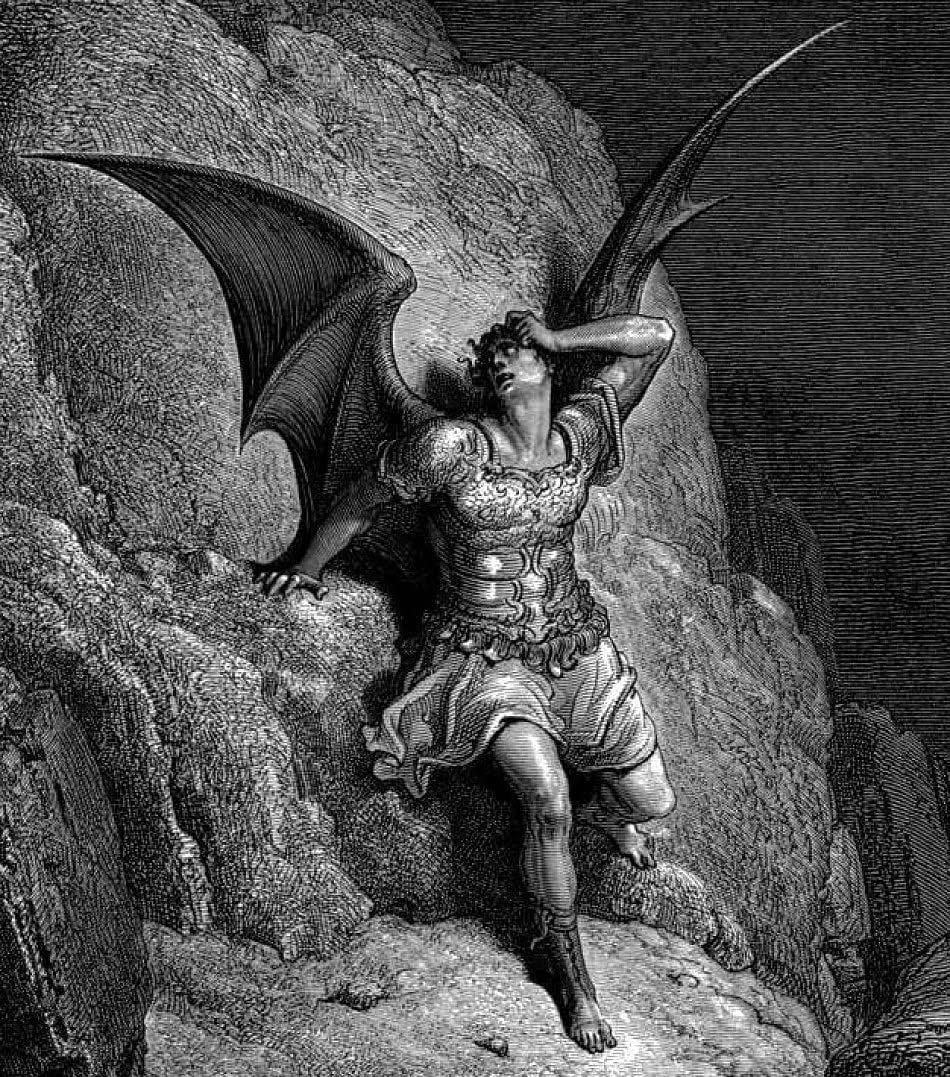
- Author / Source
- John Milton (1608–1674)
- Period
- Restoration England; first published 1667, revised in twelve books 1674
- Form & Meter
- Epic in blank verse; invocation, catalogue, epic simile, infernal council
- Core Conflict
- Can Satan’s heroic rhetoric survive the poem’s providential argument that his freedom is self-destroying?
I. The Executive Dispatch (TL;DR)
- Book I is an argument about argument. Milton begins by announcing a theodicy, then gives Satan some of the most persuasive rhetoric in English poetry. The reader is forced to feel the attraction and the danger at once.
- Satan’s heroic language is real but incomplete. “The mind is its own place” sounds like freedom; the poem will show that it is also a description of Hell.
- The fallen angels are organised, artistic, and imperial. They build Pandemonium with the same technologies and ambitions that produce human empires. Hell is not chaos; it is a rival order.
- The catalogue of demons turns biblical and classical history into a warning. The fallen angels become the false gods of the nations, and the poem’s reader is asked to recognise the pattern.
- The one-line exam takeaway: Book I makes Satan magnificent in order to make his magnificence a problem.
II. Historical & Intellectual Context (“The Backstory”)
Milton, revolution, and restoration
John Milton was born in London in 1608, educated at Cambridge, and spent the 1630s and 1640s as a poet, pamphleteer, and defender of the English revolution. He served as Latin Secretary to the Council of State under Oliver Cromwell, writing propaganda for the Commonwealth. By the time he began Paradise Lost in earnest, he was blind, politically defeated, and living under the restored monarchy of Charles II.
That context matters. Paradise Lost is not a poem of triumphant Puritanism; it is a poem written after defeat, by a man who still believed in the justice of his cause. Its grand subject — the fall of humanity and the justice of God — is also a meditation on political failure, tyranny, and the seduction of heroic language. The poem’s Satan is a rebel leader with a lost cause; the poem’s God is a monarch whose authority Satan cannot accept.
Milton published Paradise Lost in 1667 in ten books; the second edition of 1674 reorganised it into twelve books, the form in which it is usually read. He composed it in blindness, dictating to amanuenses, and he chose blank verse at a time when rhymed heroic couplets dominated English poetry. His prefatory note defends “the troublesome and modern bondage of rhyming” and claims the “ancient liberty” of the epic.
The epic tradition and the Christian sublime
Milton’s poem is deliberately classical and deliberately biblical. It invokes the Heavenly Muse rather than the classical Muses, but it also claims to surpass “th’ Aonian mount” and to pursue “things unattempted yet in prose or rhyme” (1.15–16). It uses the machinery of epic — councils, battles, catalogues, similes, journeys — while reorienting them toward Christian salvation history.
The result is a poem of immense ambition. Its scale is cosmic, its syntax often Latin, its allusions dense. But its central drama is intimate: a choice made by two human beings in a garden. Book I prepares for that intimacy by showing the opposite: a world of heroic rhetoric, imperial architecture, and endless war.
III. Structural & Formal Architecture
Blank verse and the epic voice
Paradise Lost is written in blank verse: unrhymed iambic pentameter. The form gives Milton flexibility to stretch syntax across lines, to interrupt the metre with proper names and Latin constructions, and to create a voice that feels both public and inward. Rhyme would impose closure; blank verse allows the poem to keep thinking.
The narrator’s voice is central. He is not a neutral reporter. He announces his purpose, invokes divine aid, and repeatedly interprets the action. Yet he also gives Satan long, eloquent speeches and allows the reader to feel their power. The poem’s meaning lies in the tension between the narrator’s judgement and the dramatic sympathy his characters elicit.
The invocation and the argument
The poem begins with an invocation that is also a thesis:
“Of Man’s first disobedience, and the fruit / Of that forbidden tree whose mortal taste / Brought death into the World, and all our woe…” (1.1–3)
The first word is “Of,” a classical opening, but the subject is Christian: disobedience, forbidden fruit, death, and woe. The invocation asks the Heavenly Muse to “justify the ways of God to men” (1.26). That phrase is the poem’s declared project. It is also a problem: the poem must show that God is just while giving evil its most seductive voice.
Epic catalogue and epic simile
Book I is built from epic conventions. The fallen angels are numbered and named in a catalogue (1.376–521); the demons are compared to locusts, barbarian invasions, and fallen leaves. The catalogue is not antiquarian decoration. It connects the fallen angels to the false gods of the Bible and the classical world, and it turns the poem’s present into a history of idolatry.
Milton’s similes often exceed their immediate purpose. Satan’s shield is “like the moon” seen through Galileo’s telescope (1.287–91); his spear is compared to a Norwegian pine (1.292–94); his legions are “thick as autumnal leaves” (1.302). The similes open vistas of science, trade, and empire. They make Satan’s world feel large, and they make the reader aware of the poem’s own historical moment.
IV. The Chronicle: Section-by-Section Breakdown
The Invocation (1.1–26)
The Action. Milton announces his subject, invokes the Heavenly Muse, and asks the Spirit to illumine what is dark in him. He states the poem’s purpose: to “assert Eternal Providence, / And justify the ways of God to men.”
Key Evidence.
“Of Man’s first disobedience, and the fruit / Of that forbidden tree…” (1.1–2)
The opening is both a narrative beginning and a theological judgement. The poem will tell a story, but it will also argue about that story’s meaning.
The Subtext. The invocation places the poet in a line of biblical prophets and classical epic poets. It also establishes the poem’s central risk: a story about disobedience must enter the mind of the disobedient. The reader’s sympathy is part of the test.
Hell and the Fallen Angels (1.27–83)
The Action. Satan and his legions lie on a burning lake, stunned after their defeat. Satan lifts his head, surveys the “dismal situation waste and wild,” and sees Beelzebub beside him.
Key Evidence.
“No light; but rather darkness visible / Served only to discover sights of woe…” (1.63–64)
“Darkness visible” is the poem’s first great paradox. Hell is a place where light does not illuminate; it only reveals suffering.
The Subtext. Hell is not a simple absence of God. It is a created condition, a prison ordained by “Eternal Justice.” The poem insists that the fallen angels’ suffering is real and that it is not arbitrary.
Satan and Beelzebub (1.84–248)
The Action. Satan speaks to Beelzebub, refusing to repent. He recalls the “unconquerable will” and “study of revenge” that remain after defeat. Beelzebub wonders whether God has left them strength only to suffer. Satan answers that they can still do evil, and that doing evil is their “sole delight.”
Key Evidence.
“What though the field be lost? / All is not lost—the unconquerable will, / And study of revenge, immortal hate…” (1.105–07)
Satan turns military defeat into a rhetorical victory. The lines are stirring because they refuse despair; they are also a definition of damnation.
“To do aught good never will be our task, / But ever to do ill our sole delight…” (1.159–60)
The sentence reveals the emptiness beneath the heroism. Satan’s freedom is real, but it has chosen a goal that can only destroy.
The Subtext. Satan’s rhetoric is the poem’s first temptation of the reader. He sounds like a defeated general refusing to surrender, and the epic idiom invites admiration. But his logic is circular: he defines himself by opposition to God, and therefore cannot imagine a good he does not oppose.
“The Mind Is Its Own Place” (1.249–282)
The Action. Satan reaches the shore of Hell and delivers a soliloquy. He bids farewell to the “happy fields” of Heaven, hails the “infernal world,” and claims that the mind can make a Heaven of Hell or a Hell of Heaven. He concludes that it is “better to reign in Hell than serve in Heaven.”
Key Evidence.
“The mind is its own place, and in itself / Can make a Heaven of Hell, a Hell of Heaven.” (1.254–55)
The lines are often quoted as a celebration of mental freedom. In context, they are a description of Satan’s self-imprisonment. The mind can make a Hell of Heaven; that is precisely what Satan has done.
“Better to reign in Hell than serve in Heaven.” (1.263)
The line is memorable because it is a political slogan. It also reveals Satan’s scale of values: rule is worth more than beatitude.
The Subtext. Satan’s soliloquy is the rhetorical centre of Book I. It converts defeat into a program, and it gives the reader a seductive model of heroic self-assertion. The poem will spend the rest of its length testing that model.
The Fallen Host and the Catalogue (1.283–621)
The Action. Satan calls his legions. They rise from the lake “thick as autumnal leaves,” and Milton catalogs their leaders: Moloch, Chemos, Astarte, Thammuz, Dagon, Rimmon, Belial, and others. The catalogue links them to the false gods of the Old Testament and the classical world.
Key Evidence.
“Awake, arise, or be for ever fallen!” (1.330)
Satan’s call is a parody of divine creation: he summons the fallen into a kind of life, but it is a life of continued rebellion.
“His form had yet not lost / All her original brightness…” (1.591–92)
Milton never lets us forget what Satan was. The “ruined Archangel” is both diminished and magnificent, and that double vision is the source of the poem’s difficulty.
The Subtext. The catalogue turns the fallen angels into the gods of the nations. The poem is not only telling a story about the past; it is explaining the origin of idolatry, empire, and false worship. The fallen host is a political and religious warning.
Pandemonium and the Infernal Council (1.622–798)
The Action. The fallen angels mine gold, build Pandemonium, and gather for a council. The architecture is compared to Babylon and Memphis; the palace is lit by “starry lamps” and filled with the “great consult.”
Key Evidence.
“At Pandemonium, the high capital / Of Satan and his peers…” (1.756–57)
Pandemonium is a parody of the heavenly city and a model of imperial politics. It is built by forced labour, decorated with wealth, and designed to concentrate power.
“And summons read, the great consult began.” (1.798)
The book ends with a parliamentary session in Hell. The epic’s first major action is not a battle but a debate.
The Subtext. Hell is not merely a place of pain; it is a society. It has leaders, workers, artists, and a political system. Milton’s satire is aimed at the ways human institutions reproduce infernal logic: grandeur built on extraction, counsel that masks ambition, and rhetoric that calls domination freedom.
V. The Editorial Board: Deep Thematic & Critical Analysis
Heroic rhetoric and moral judgement. Satan speaks in the idiom of epic heroism: defiance, endurance, leadership, and scorn for ease. Milton gives him some of the poem’s finest lines. But the narrator frames those lines with judgements: Satan is “racked with deep despair,” his “vaunting” is hollow, and his heroism is directed toward evil. The poem does not resolve the tension by making Satan obviously villainous. It makes him attractive and then asks the reader to notice what the attraction costs.
“Darkness visible” and the poetics of paradox. Milton’s Hell is built on paradoxes: darkness that reveals, freedom that imprisons, greatness that is ruin. These paradoxes are not wordplay. They express the poem’s theology: evil has no independent substance; it is a privation or distortion of good. Satan’s splendour is real because it is leftover from his original brightness, but it is also fading.
The mind’s autonomy and its limits. “The mind is its own place” is one of the most important statements in the poem. It affirms the inwardness of human experience and the power of interpretation. But it also warns that the mind can construct a false world. Satan’s autonomy is not freedom from God; it is freedom to torment himself.
Tyranny, consent, and the infernal council. Pandemonium is a parody of political assembly. The fallen angels debate, but their debate is shaped by Satan’s authority and by their shared commitment to war. Milton, the republican polemicist, is not simply celebrating deliberation; he is showing how rhetoric can manage consent in a tyrannical system.
Classical epic and Christian epic. Milton uses the epic tradition and transforms it. The classical hero seeks glory; the Christian hero seeks obedience. Satan is a classical hero in a Christian poem, and that mismatch is his tragedy. The poem’s true hero, if it has one, is the Son, whose heroism is defined by sacrifice rather than conquest.
The reader’s sympathy. Book I is a training ground for the reader. It teaches us to admire eloquence, then to ask what the eloquence is for. The poem’s ethical force depends on our willingness to be moved and to judge at the same time.
VI. Exam & Essay Sparkplugs
1. “Book I makes Satan a hero only to expose the poverty of heroism.” Discuss.
Winning Thesis Blueprint. Milton gives Satan the language and gestures of epic heroism, but the poem frames that heroism as self-destructive and rhetorically hollow. The reader is invited to admire Satan and then to recognise that admiration is part of the temptation.
Supporting points.
- Satan’s “unconquerable will” and “study of revenge.”
- The narrator’s descriptions of Satan’s despair and ruined brightness.
- The contrast between Satan’s heroism and the Son’s sacrificial heroism later in the poem.
2. “Pandemonium is the true image of Hell.” How far do you agree?
Winning Thesis Blueprint. Pandemonium turns Hell into a society of extraction, spectacle, and political management, making it a more disturbing image of evil than the burning lake. The poem suggests that evil is not only pain but also the institutional reproduction of domination.
Supporting points.
- The mining and building of Pandemonium.
- The architecture’s resemblance to Babylon and Memphis.
- The council as a parody of deliberation.
3. “‘The mind is its own place’ is Satan’s greatest lie.” Examine the line in context.
Winning Thesis Blueprint. The line is true in a limited sense — the mind shapes experience — but Satan uses it to deny his dependence on God and to justify his self-imposed Hell. The poem turns the line into a diagnosis rather than a doctrine.
Supporting points.
- The soliloquy’s movement from farewell to self-assertion.
- The narrator’s framing of Satan’s “vaunting” and despair.
- The contrast with Adam and Eve’s later understanding of inward freedom.