Sir Gawain and the Green Knight: The Complete Study Dispatch
Chivalry, pentangles, and the beheading game in fourteenth-century England
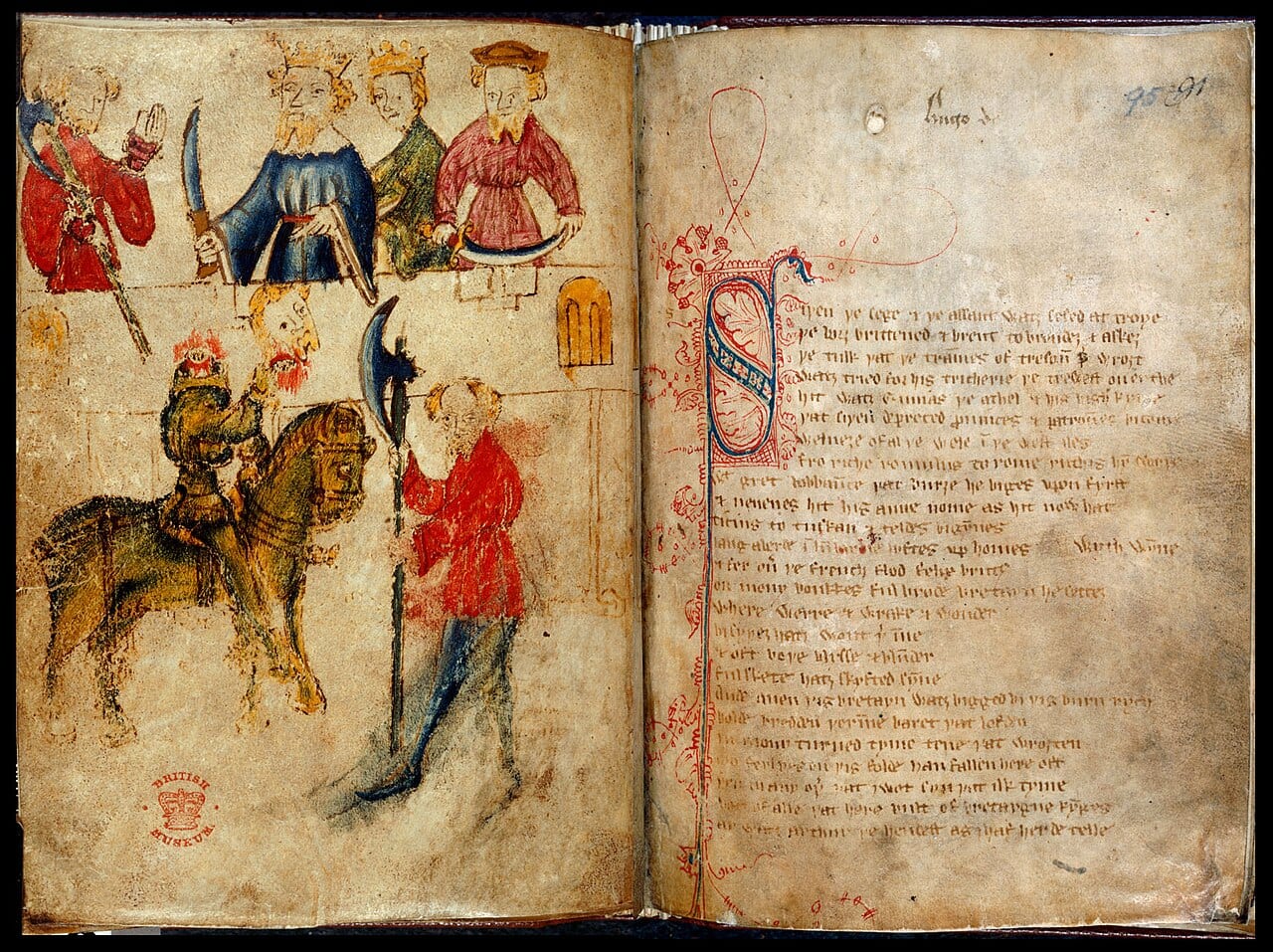
- Author / Source
- The Pearl Poet (anonymous; Cotton Nero A.x)
- Period
- Late fourteenth century (c. 1375–1400), West Midlands
- Form & Meter
- Arthurian romance in alliterative verse with bob and wheel
- Core Conflict
- Can a chivalric code founded on reputation survive a test that turns on secrecy, fear, and the instinct to live?
I. The Executive Dispatch (TL;DR)
- The poem is a contract story before it is an adventure story. A stranger enters Arthur’s hall, offers a game, and converts Christmas festivity into a legally binding exchange of blows. Everything that follows tests whether Gawain’s word is worth more than his life.
- The beheading is a trap with a theological shape. Gawain keeps the first contract perfectly and then discovers that the second contract has been rearranged around him: the Green Knight is Bertilak, the castle is the testing ground, and the three temptations are the real blows.
- The pentangle sets the standard; the girdle measures the gap. Gawain’s shield advertises flawless “trawthe,” but the green girdle he hides proves that even the best knight will choose survival over transparency. The poem is less interested in whether Gawain falls than in how he understands the fall.
- The ending is deliberately unresolved. Arthur’s court laughs, adopts the green girdle as a badge of honour, and absorbs Gawain’s shame into collective identity. The reader is left to decide whether that is forgiveness, trivialisation, or the romance’s final irony.
- The one-line exam takeaway: Sir Gawain tests the difference between reputation and virtue — between the pentangle a knight wears and the secret he carries.
II. Historical & Intellectual Context (“The Backstory”)
The Pearl Poet and the Cotton Nero manuscript
The poem survives in a single manuscript, British Library Cotton Nero A.x, copied around 1400 and containing four works in the same West Midlands dialect: Pearl, Cleanness, Patience, and Sir Gawain and the Green Knight. The author is anonymous. The traditional name, “the Pearl Poet” or “the Gawain-poet,” is a convenience derived from the most famous companion poem, not a recovered identity.
That anonymity matters for interpretation. We cannot anchor the poem to a named court, patron, or biography. We can, however, locate it in the late fourteenth century: a period of plague, war with France, peasant unrest, papal schism, and intense anxiety about the moral health of the English church. The poem’s Arthurian setting is deliberately archaic. It reaches back to a legendary British past while speaking to a present in which chivalry was both a lived code and a nostalgic performance.
The manuscript is modest, even provincial, but the poem is not naive. Its learned Latin and French allusions, its legal vocabulary of covenants and agreements, and its theological precision suggest a writer at home in clerical and courtly culture. The famous opening does not begin with Arthur. It begins with Troy, empire, and ruin:
“SIÞEN þe sege and þe assaut watȝ sesed at Troye, / Þe borȝ brittened and brent to brondeȝ and askeȝ…” (1–2)
When the siege and assault had ceased at Troy, and the city was broken and burned to brands and ashes…
That is a warning. Arthur’s Camelot is the latest in a series of glittering civilisations, and the poem’s festive opening sits on top of historical wreckage.
Chivalry, the alliterative revival, and the Arthurian frame
The fourteenth century was the great age of English chivalric display: tournaments, orders of knighthood, heraldic pageantry, and romances. It was also an age of criticism. Piers Plowman rails against corrupt knights and clergy; Sir Gawain is subtler, but it shares the period’s obsession with whether the chivalric code can be lived rather than merely worn.
The poem belongs to what scholars call the Alliterative Revival. After the Norman Conquest, English alliterative verse did not disappear, but the late fourteenth century produced a remarkable cluster of long poems in a revived four-stress, alliterating line. Sir Gawain uses that older form for a sophisticated Arthurian romance, a combination that is itself a statement: the poem looks backward metrically while examining the present.
Arthur’s court is presented as young, beautiful, and slightly childish. Arthur refuses to eat until he hears a marvel; the court is “in her first age” (line 54), full of “rechles merþes” — careless joys. The Green Knight enters not merely as a monster but as a critic of this courtly surface. His first words ask for “the governour of this gyng” (225), and his challenge exposes the gap between the Round Table’s reputation and its willingness to act.
III. Structural & Formal Architecture
The alliterative line
The poem is written in unrhymed alliterative verse: long lines divided by a caesura into two half-lines, with four stressed syllables and alliteration binding the halves together. The pattern is flexible, but the effect is insistent, almost hammering. It gives the poem its oral, public texture — the sound of a story being recited in a hall.
Alliteration is not decoration. It organises meaning. When the poet describes the Green Knight as “oueral enker grene” (150), the hard g and k sounds make the colour feel like a physical property. When Gawain’s blade cuts through the neck, the verse itself seems to chop:
“Þat þe scharp of þe schalk schyndered þe bones, / And schrank þurȝ þe schyire grece, and scade hit in twynne” (424–25)
The clustered sch and sk sounds are the sound of the blow. Formal analysis should always ask what the alliteration is doing, not merely note that it exists.
The bob and wheel
Each stanza ends with a bob and wheel. The bob is a short, usually two-syllable line; the wheel is four rhyming lines, often with a different rhythm. The device functions like a refrain or a hinge: it comments on the stanza, shifts register, or crystallises an emotion.
The most famous example closes the beheading scene. After the Green Knight picks up his severed head and rides out, the court laughs:
“What þenne? / Þe kyng and Gawen þare / At þat grene þay laȝe and grenne, / Ȝet breued watȝ hit ful bare / A meruayl among þo menne.” (464–68)
The bob (“What then?”) is almost colloquial; the wheel turns horror into social laughter. That tonal swerve is characteristic. The poem repeatedly uses the bob and wheel to show how a community manages fear — by making it a story, a joke, a game.
Four fits, one contract
The poem is divided into four fits, or sections:
| Fit | Lines | Movement |
|---|---|---|
| I | 1–490 | Camelot, the Green Knight’s challenge, the beheading, the appointment at the Green Chapel |
| II | 491–1125 | Gawain’s journey, the wilderness, the sudden arrival at Bertilak’s castle, the exchange agreement |
| III | 1126–1997 | The three hunts, the three bedroom temptations, the exchange of winnings, the girdle |
| IV | 1998–2530 | The journey to the Green Chapel, the three blows, the revelation, the return to Camelot |
The structure is symmetrical: a contract in Fit I, a journey in Fit II, a triple test in Fit III, and a settlement in Fit IV. The middle fit’s hunting scenes and bedroom scenes are intercut, so that the reader experiences the same pattern of pursuit, capture, and exchange from two angles. The poem is built like a game with rules — and like a game, it depends on the players not knowing all the rules at once.
IV. The Chronicle: Section-by-Section Breakdown
Fit I — The Challenge at Camelot (lines 1–490)
The Action. Arthur’s court celebrates Christmas and New Year. A gigantic green knight rides into the hall, entirely green, carrying a holly branch in one hand and a great axe in the other. He offers a “Crystemas gomen”: one knight may strike him now, on condition that the blow be returned a year and a day later. Arthur accepts, but Gawain asks to take the challenge in his place. Gawain beheads the Green Knight. The knight picks up his head, reminds Gawain of the appointment, and rides out. The court hangs the axe above the high table.
Key Evidence.
“Bot in his on honde he hade a holyn bobbe, / Þat is grattest in grene when greueȝ ar bare, / And an ax in his oþer…” (206–08)
The holly and the axe are a miniature emblem of the poem: peace and violence, nature and war, life and death carried in the same body.
“I am þe wakkest, I wot, and of wyt feblest, / And lest lur of my lyf…” (355–56)
Gawain’s self-deprecation is both genuine humility and a rhetorical move. He takes the game because he believes his life is worth least; the poem will test whether that belief is true.
The Subtext. The challenge is a critique of Arthur’s court. The Green Knight asks for the “governour” and finds a boyish king who wants a marvel before dinner. Gawain’s intervention saves the court’s honour, but it also exposes the court’s dependence on a single knight’s willingness to die for its reputation. The beheading is a parody of chivalric display: the most spectacular blow in the poem produces no victory, only a contract.
Fit II — The Journey and the Castle (lines 491–1125)
The Action. Gawain leaves Camelot. The poem lingers on the passage of the seasons, the harsh winter landscape, and Gawain’s isolation. He fights monsters, suffers cold, and prays. On Christmas Eve he comes upon a beautiful castle in the wilderness. Bertilak, the lord, welcomes him lavishly. Gawain explains that he is seeking the Green Chapel and must leave on New Year’s Day. Bertilak proposes an exchange: while he hunts, Gawain will rest in the castle, and each evening they will trade whatever they have won.
Key Evidence.
“Where werre and wrake and wonder / Bi syþeȝ hatȝ wont þerinne, / And oft boþe blysse and blunder / Ful skete hatȝ skyfted synne.” (16–19)
The opening’s wheel sets the pattern for the whole poem: war, vengeance, wonder, bliss, and blunder succeed one another with terrifying speed.
“For I haf fraysted þe twys, and faythful I fynde þe. / Now ‘þrid tyme þrowe best’…” (1679–80)
Bertilak’s lines in Fit III retrospectively reveal that the castle has been a testing ground all along. In Fit II, however, the reader experiences it as refuge — which is exactly the trap.
The Subtext. The castle is the poem’s most seductive space: warm, civilised, full of food, talk, and beauty. It is also the opposite of the wilderness Gawain has just crossed. The contrast is not simply nature versus culture. The castle is a machine for testing courtesy, and its hospitality is a form of surveillance. Bertilak’s exchange agreement turns every private moment into a potential debt.
Fit III — Three Hunts and Three Temptations (lines 1126–1997)
The Action. Bertilak hunts a deer, a boar, and a fox on three successive days. Each day, the lady of the castle visits Gawain in his bed and tests him with increasingly direct advances. Gawain parries with courtesy, accepting kisses but refusing sexual betrayal. Each evening, he exchanges the kisses with Bertilak for the day’s game. On the third day, the lady offers him a green girdle that she says will protect him from any blow. Gawain accepts it, hides it, and fails to hand it over in the final exchange.
Key Evidence.
“Ȝet I kende yow of kyssyng,” quoþ þe clere þenne, / “Quere-so countenaunce is couþe quikly to clayme…” (1490–91)
The lady turns courtesy into a contract. Gawain’s verbal skill cannot neutralise the situation because the rules of courtesy themselves are being used against him.
“For he myȝt not be slayn for slyȝt vpon erþe.” (1854)
The lady’s claim about the girdle is the serpent’s whisper of the poem. It offers exactly what Gawain most wants: survival without having to trust God, honour, or the Green Knight’s mercy.
The Subtext. The three hunts are a commentary on the bedroom scenes. The deer is shy and must be driven; the boar is fierce and dangerous; the fox is cunning and elusive. Each animal corresponds to a phase of the temptation, and each day’s game is brought home and exchanged. The poem cross-cuts between the hunt and the bedchamber so that the reader sees Gawain as both hunter and prey. The girdle is the one object that escapes the exchange, and that exception is the whole moral crisis.
Fit IV — The Green Chapel and the Return (lines 1998–2530)
The Action. Gawain leaves the castle, guided to the Green Chapel. He finds not a chapel but a grassy mound or cave in a wild landscape. The Green Knight appears, sharpens his axe, and prepares to strike. On the first blow, Gawain flinches; the knight mocks him. On the second, the knight stops short. On the third, he gives Gawain a slight nick on the neck. He then reveals himself as Bertilak, explains that Morgan le Fay orchestrated the test, and interprets the three blows as the three exchanges: the first two are feints because Gawain was truthful; the third draws blood because Gawain hid the girdle. Gawain curses cowardice and covetousness, confesses, and accepts the girdle as a badge of his fault. Back at Camelot, the court laughs and adopts the green girdle as a mark of honour.
Key Evidence.
“Hit is þe corsedest kyrk þat euer I com inne!” (2196)
Gawain’s horror at the chapel is also a horror at the poem’s refusal of conventional romance geography. The Green Chapel is not a sacred building but a natural hollow, a grave-like space where the chivalric code is stripped of its scenery.
“Bot here yow lakked a lyttel, sir, and lewté yow wonted; / Bot þat watȝ for no wylyde werke, ne wowyng nauþer, / Bot for ȝe lufed your lyf; þe lasse I yow blame.” (2366–68)
Bertilak’s judgement is the poem’s most important sentence. Gawain’s failure is not lust or malice; it is the love of life. The Green Knight forgives what the code cannot.
“Corsed worth cowarddyse and couetyse boþe! / In yow is vylany and vyse þat vertue disstryeȝ.” (2374–75)
Gawain’s self-curse is excessive, even theatrical. He has internalised the code so thoroughly that a single lapse becomes total identity: he is “fawty and falce” (2382). The poem asks whether that severity is heroic, pathological, or both.
The Subtext. The three blows are a miniature of the poem’s ethics. The first two are withheld because Gawain kept faith; the third lands because he did not. Yet the Green Knight’s judgement is gentler than Gawain’s own. The poem distinguishes between the failure and the meaning of the failure. Gawain learns that he is not the pentangle; he is a man who wants to live. The green girdle becomes the sign of that knowledge, and the court’s decision to wear it turns private shame into public memorial.
V. The Editorial Board: Deep Thematic & Critical Analysis
Trawthe and the economics of the word. The poem is obsessed with contracts: the beheading agreement, the exchange of winnings, the lady’s requests, the girdle’s promise. Trawthe is not merely honesty; it is the capacity to make one’s word hold across time. Gawain’s tragedy is that he treats the girdle as a private insurance policy inside a system of public vows. The poem asks whether any code can survive the discovery that self-preservation is also a value.
The pentangle versus the girdle. The pentangle is an emblem of totality: five wounds, five joys, five senses, five virtues, an endless knot. It is also a public image, worn on a shield. The girdle is private, hidden, and worn under armour. The poem sets the two symbols against each other: the pentangle says this is what a knight should be; the girdle says this is what a man is afraid of. The strongest readings refuse to choose between them. The poem’s ethics lie in the gap.
The green as a crisis of interpretation. Green is the colour of life, growth, and the natural world, but also of decay, poison, and the uncanny. The Green Knight is both a Christmas game-master and a figure of the grave. He carries holly (peace) and an axe (violence). He is “half etayn” (140), a half-giant, and yet he is also Bertilak, a courteous host. Critics have read him as a Green Man, a vegetation spirit, a devil, a Christ-figure, and a projection of the court’s own aggression. The poem does not settle the question, and that is the point: green is the sign of meaning that will not stay fixed.
The hunt, the bed, and the gaze. The intercutting of hunt and bedroom creates a continuous field of pursuit. Bertilak hunts animals; the lady hunts Gawain; the poem hunts the reader’s sympathy. Gawain is repeatedly described in passive, objectified terms: he lies in bed, he is looked at, he is kissed. The poem’s gender dynamics are not simple inversion. The lady is powerful within the bedroom, but her power is scripted by her husband and by Morgan. The result is a world in which everyone is playing a role in someone else’s game.
The ending and the ethics of laughter. Arthur’s court laughs at Gawain’s story and adopts the girdle. Is this forgiveness, or the absorption of a disturbing truth into fashion? The poem’s final wheel praises the Round Table’s renown, but the last lines return to the fall of Troy and the passing of all things. The laughter is not the end of the poem’s anxiety; it is the sound the court makes to keep that anxiety at bay.
VI. Exam & Essay Sparkplugs
1. “Sir Gawain and the Green Knight is less interested in whether Gawain fails than in how he understands his failure.” Discuss.
Winning Thesis Blueprint. The poem treats the girdle not as a simple moral lapse but as a hermeneutic crisis: Gawain’s shame reveals that chivalric identity depends on public signs, while the Green Knight’s forgiveness exposes the limits of that code. A strong essay can argue that the poem distinguishes between the failure of the man and the failure of the system that taught him to read himself.
Supporting points.
- The pentangle’s public symbolism versus the girdle’s secrecy.
- Bertilak’s judgement (“þe lasse I yow blame”) as a rival ethical framework to Gawain’s self-curse.
- The court’s laughter and adoption of the girdle as the poem’s unresolved ending.
2. “The Green Knight is not a monster but a critic of Arthurian chivalry.” How far do you agree?
Winning Thesis Blueprint. The Green Knight’s challenge exposes the court’s preference for reputation over risk, and his later role as Bertilak reveals that the entire adventure has been a controlled critique of chivalric self-fashioning. Yet the poem also gives him an uncanny, festive, and finally generous authority that complicates any reading of him as a mere satirist.
Supporting points.
- The holly and axe as symbols of peace and violence.
- The court’s initial silence and Arthur’s impulsive acceptance.
- Bertilak’s forgiveness and the revelation of Morgan’s orchestration.
3. “The poem’s form is its argument.” Examine the relationship between alliterative verse, the bob and wheel, and the poem’s ethical concerns.
Winning Thesis Blueprint. The alliterative line’s four stresses and caesura enact the poem’s central rhythm of contract and interruption, while the bob and wheel repeatedly convert violence into social commentary. Form is not ornament but a way of testing whether a story can contain the contradictions it exposes.
Supporting points.
- The beheading scene’s sound patterning and the wheel’s tonal swerve.
- The intercutting of hunt and bedroom as a structural rhyme.
- The final wheel’s return to Troy and the poem’s refusal of closure.