The Line and the Turn: A Field Guide to Poetry Terminology
Meter, rhyme, figuration, and form — the vocabulary of close reading, from the iamb to the volta
- Author / Source
- The Study Herald Arts & Letters Desk
- Period
- English poetry from Old English to the present
- Form & Meter
- Prosody, rhetoric, figuration, and form
- Core Conflict
- The name of a device versus the effect it produces in a particular poem.
I. The Executive Dispatch (TL;DR)
- Terminology is a set of tools for noticing, not a password. A term gives you a place to look; it does not tell you what you have found or why it matters.
- Meter is a pattern; rhythm is a performance. Scan the line to see the pattern, then read it aloud to hear what the pattern does in the ear.
- Line breaks are the poem’s first punctuation. End-stopped, enjambed, and caesural lines create three different kinds of pause.
- Rhyme is structure and expectation. A perfect rhyme closes; a slant rhyme unsettles; a couplet can make a conclusion sound inevitable or ironic.
- Figuration is argument. Metaphor, metonymy, synecdoche, and personification do different intellectual work, and the difference matters.
- Form is a promise the poem can keep, break, or revise. A sonnet is not just fourteen lines; it is a shape of thought with a history.
- The one-line takeaway: name the device, describe the effect, make a claim about meaning. If you stop at the name, you have not yet written analysis.
II. Why Terminology Matters (and When It Doesn’t)
Terms are tools for noticing
A term directs attention. Volta tells you to watch for the moment a poem changes its mind. Synecdoche tells you to ask what part is standing in for what whole. Feminine ending tells you to listen for the extra unstressed syllable that leaves a line hanging. Without the term, you might register a vague effect and move on. With it, you have a question to ask of the text.
This is the case for learning terminology properly. The point is not to decorate a paragraph with Greek words. The point is to see more. A student who knows what an alexandrine is will notice that a Spenserian stanza ends with a longer line; a student who does not may read the stanza as uniformly regular and miss the formal signal.
The device-hunting problem
The opposite failure is just as common. Students are taught to identify devices, and they learn to spot them the way a birdwatcher spots species. The poem becomes a list: enjambment, alliteration, metaphor, caesura. Nothing is wrong with the list except that it is not a reading.
A device is only interesting when it does something. The test is simple: can you replace the device’s name with a sentence about its effect? If you cannot, you have not yet understood the device in this poem. The poem uses enjambment becomes the sentence runs past the line break and makes the reader wait for its verb. The second sentence is not more sophisticated; it is simply doing the work the first one announced.
Description, analysis, interpretation
It helps to separate three levels of response:
- Description: “The couplet rhymes on a stressed monosyllable and is end-stopped.”
- Analysis: “The closed rhyme and the full stop make the conclusion sound settled.”
- Interpretation: “That settled sound is ironic, because the poem’s promise of immortality depends on the poem being read.”
The levels are not a rigid ladder, but they are a useful diagnostic. Most weak paragraphs stop at description. Most strong paragraphs move from description to analysis and then risk an interpretation. The interpretation may be arguable; that is what makes it worth writing.
A note on editions and line numbers
Cite poems by line number, not page number, unless your instructor asks otherwise. Use the edition on your syllabus: line breaks, punctuation, spelling, and even stanza divisions can differ between editions, and a reading that depends on a comma may collapse if the comma is an editorial addition. When you quote, quote accurately. When you scan, scan the text in front of you.
III. How English Verse Was Built: A Short History of the Line
Old English: stress and alliteration
Old English poetry — Beowulf, The Wanderer, The Seafarer — is built on stress and alliteration rather than syllable count and end rhyme. A typical line has four stressed syllables, divided into two half-lines by a caesura, with alliteration binding the stressed words across the break:
Hwæt! Wē Gārdena in geārdagum
(“Listen! We have heard of the Spear-Danes in the old days.”) The line is not organized by a fixed number of syllables or by a recurring foot. It is organized by the weight of stressed words and the pattern of their initial sounds. This is the tradition that returns, transformed, in Sir Gawain and the Green Knight and in the alliterative revival of the fourteenth century.
Middle English: rhyme arrives
After the Norman Conquest of 1066, French and Latin models brought rhyme and syllable-counting into English verse. Chaucer’s Troilus and Criseyde uses rhyme royal — seven lines of iambic pentameter rhyming ababbcc — and his decasyllabic line is one of the ancestors of the pentameter that would dominate English poetry for centuries. Alliterative verse did not disappear; it coexisted with the new rhymed forms, as Sir Gawain and Piers Plowman show.
The Middle English period is a laboratory. Poets are experimenting with French forms, Latin rhetoric, native alliteration, and a language still sorting out its stress patterns. When you read Chaucer, you are watching English poetry decide what kind of thing it wants to be.
The Renaissance: pentameter and blank verse
In the sixteenth century, Wyatt and Surrey imported the sonnet from Italy. Surrey also developed blank verse — unrhymed iambic pentameter — in his translation of the Aeneid. Marlowe and Shakespeare made blank verse the instrument of English drama, flexible enough for speech and formal enough for argument. The sonnet became a shape for sequences of love, devotion, and self-scrutiny: Petrarchan in structure, Shakespearean in its three quatrains and couplet, Spenserian in its interlocking rhymes.
This is also the period in which English poets tried to write quantitative verse on the classical model — counting long and short syllables rather than stresses — and largely failed, because English is a stress-timed language. The failure is instructive. English metre is built on stress, not duration, and the terms we use for English prosody are often borrowed from a system that does not quite fit.
The couplet and the ode
The seventeenth and eighteenth centuries made the closed heroic couplet a machine for argument and satire. Dryden and Pope use rhyming iambic pentameter in couplets that end-stopped, balanced, and epigrammatic; the form rewards wit and punishes vagueness. At the same time, the ode offered a larger, more public lyric: Pindaric odes with their strophe, antistrophe, and epode; Horatian odes in a repeated stanza; and later irregular odes that keep the elevated address without the classical architecture. Gray’s Elegy Written in a Country Churchyard shows the elegiac quatrain working at a measured pace; Pope’s Rape of the Lock shows the mock-epic turning epic machinery into social satire.
Free verse and after
Walt Whitman’s Leaves of Grass (1855) made the long, unrhymed, syntactically driven line a serious alternative to metrical verse. French vers libre and the modernists pushed further: Eliot, Pound, H.D., and Williams treated the line as a unit of attention, breath, and juxtaposition rather than a metrical template. The result is not the absence of form. It is the visible making of form — the line break doing the work that metre and rhyme once did.
Contemporary poetry includes all of these possibilities at once: strict forms, slant forms, free verse, prose poetry, and poems that move between them. The history matters because the terms carry it. When you call a poem “blank verse,” you are placing it in a lineage; when you call it “free verse,” you are making a different claim about how its lines are organized.
IV. The Architecture of a Poem
Line and line break
A line is not a sentence. It is a unit of attention, and the break at its end is a decision. The break can complete a phrase, interrupt it, isolate a word, create a double meaning, or make the reader wait for the verb. Lineation is the poem’s first punctuation, and often its most important one.
Consider the difference between:
The door was open when I came home.
and
The door was open when I came home.
The words are the same; the information is not. The line break makes “The door was open” a unit of perception, and “when I came home” an afterthought or a condition. The poem has not changed its content, but it has changed its timing.
End-stopped, enjambed, caesural
Three terms cover most of the ways a line can pause:
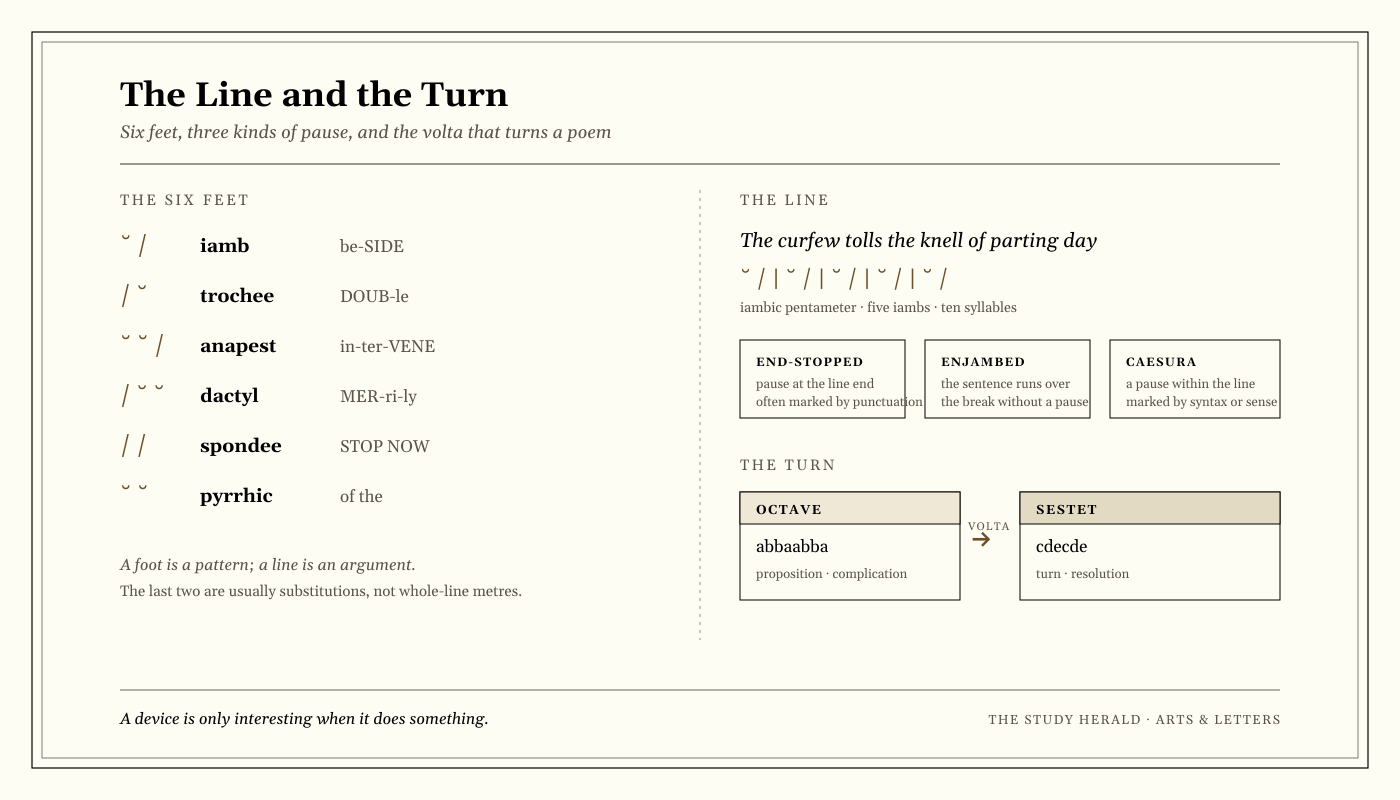
- End-stopped: the line ends with a pause, usually marked by punctuation. “The curfew tolls the knell of parting day,” — the comma makes the line a closed unit.
- Enjambed: the sentence runs over the line break without a pause. “That time of year thou mayst in me behold / When yellow leaves, or none, or few, do hang” — the reader is pulled across the break to find out what is beheld.
- Caesural: there is a pause within the line, often marked by syntax or punctuation. “To be, or not to be, that is the question” — the comma after “be” opens a space in the middle of the line.
These are not three moods of the same device. End-stopping creates closure; enjambment creates suspense and forward motion; caesura creates a break inside the line that can isolate a word or divide a thought. A poem can use all three within a few lines, and the pattern of their use is part of its argument.
The stanza
Stanza comes from the Italian for “room” or “stopping place.” A stanza is a group of lines set off by white space, and it is both a visual and a conceptual unit. The common names are simple: couplet (two lines), tercet (three), quatrain (four), quintain (five), sestet (six), septet (seven), octave (eight).
But stanza forms are more than counts. A quatrain can rhyme abab, abba, abcb, or aabb, and each scheme creates a different pattern of expectation. A rhyme royal stanza (ababbcc) closes with a couplet that can feel like a summary. A Spenserian stanza (ababbcbcc) ends with an alexandrine that extends the stanza beyond the pentameter it has established. The stanza is a unit of thought as well as form: it can complete an argument, hold it open, or turn it.
The turn
The volta is the turn. In a Petrarchan sonnet, it often arrives at the beginning of the sestet, after the octave has stated a problem or a proposition. In a Shakespearean sonnet, it often arrives before the final couplet, or at the couplet itself. In a free-verse poem, the turn may be a change of address, a shift in diction, a new image, or a line that suddenly complicates what came before.
Not every poem has a formal volta, but most poems have a moment of pressure where the argument changes direction. Finding that moment is often the fastest way into a poem’s meaning. Ask: where does the poem stop doing one thing and start doing another? Where does it turn from description to judgement, from complaint to consolation, from “I” to “you”?
The verse paragraph
In blank verse and free verse, poets often organize lines into verse paragraphs rather than fixed stanzas. A verse paragraph is a group of lines held together by syntax and argument, not by a rhyme scheme. Milton’s Paradise Lost, Wordsworth’s Prelude, and Whitman’s Song of Myself all use the verse paragraph to build large structures out of long, unrhymed lines. When you analyze one, look for the sentence as much as the stanza: where does the period fall, and what does the paragraph do before it gets there?
V. Meter: The Engine of the Line
Stress, syllable, and quantity
English metre is accentual-syllabic: it counts both stresses and syllables, and it organizes them into repeating patterns called feet. This is different from classical quantitative metre, which counts long and short syllables. English does have vowel length, but stress is the organizing principle, and a foot is a pattern of stressed (/) and unstressed (˘) syllables.
Stress is relative, not absolute. In be-SIDE, the second syllable is stressed because it is louder and longer than the first. In a sentence, the same word can lose its stress depending on its neighbours. This is why scansion is an argument, not a measurement: two careful readers can disagree about a line, and the disagreement is often the most interesting thing about it.
The feet
| Foot | Pattern | Name | Example |
|---|---|---|---|
| Iamb | ˘ / | iambic | be-SIDE |
| Trochee | / ˘ | trochaic | DOUB-le |
| Anapest | ˘ ˘ / | anapestic | in-ter-VENE |
| Dactyl | / ˘ ˘ | dactylic | MER-ri-ly |
| Spondee | / / | spondaic | STOP NOW |
| Pyrrhic | ˘ ˘ | pyrrhic | of the |
| Amphibrach | ˘ / ˘ | amphibrachic | re-MEM-ber |
The first four are the workhorses of English verse. Spondees and pyrrhics are usually substitutions inside a line rather than the basis of a whole metre; the amphibrach is common in comic and song verse but rare as a whole-line pattern. A line is named by its dominant foot and its number of feet: iambic pentameter, trochaic tetrameter, anapestic tetrameter, dactylic hexameter.
Line lengths
| Feet | Name | Notes |
|---|---|---|
| One | Monometer | Rare as a whole poem; often a refrain or a dramatic isolate. |
| Two | Dimeter | Short lines; common in songs and refrains. |
| Three | Trimeter | Ballad and hymn metre often alternate trimeter with tetrameter. |
| Four | Tetrameter | Common in lyric, hymn, and ballad; a flexible, songlike length. |
| Five | Pentameter | The dominant English line: sonnet, blank verse, heroic couplet. |
| Six | Hexameter | In English, iambic hexameter is an alexandrine; dactylic hexameter is the classical epic line. |
| Seven | Heptameter | Often a fourteener when broken into two tetrameter/trimeter halves. |
| Eight | Octameter | Rare; tends to break into two four-foot units. |
A line can also be catalectic (missing the final syllable of its last foot) or acatalectic (complete). Blake’s “Tyger Tyger, burning bright” is trochaic tetrameter catalectic: four trochees minus the final unstressed syllable, which makes the line stop hard, like a hammer.
How to scan a line
Scansion is a five-step habit:
- Read the line aloud normally. Do not force the metre before you hear the sentence.
- Mark the stressed syllables. Use a slash (/) for stressed and a breve (˘) or a cross (×) for unstressed.
- Count the syllables and group them into feet. Mark foot boundaries with a vertical line (|).
- Note the variations. Look for inverted feet, extra syllables, missing beats, caesuras, and enjambment.
- Read it again. Ask what the pattern does that the plain sentence would not.
Take Gray’s line:
The curfew tolls the knell of parting day
˘ / | ˘ / | ˘ / | ˘ / | ˘ /
the CUR | few TOLLS | the KNELL | of PART | ing DAY
The line is almost perfectly regular iambic pentameter. The regularity suits the elegy’s measured grief: the poem is not rushing. When a poem establishes a pattern this clearly, a deviation becomes audible. That is the advantage of regular metre: it gives the poet something to break.
Substitution and variation
Metre is not a metronome. Poets vary the pattern constantly, and the variations are where much of the meaning lives.
- Initial inversion. “Now is the winter of our discontent” opens with a trochaic foot (“NOW is”) before settling into iambs. The inversion lands on “Now,” so the line begins with a gesture rather than a rise.
- Feminine ending. “To be or not to be, that is the question” has eleven syllables: the final “-tion” is unstressed, so the line ends on a weak beat. The extra syllable leaves the question hanging rather than closing it.
- Catalexis. “Tyger Tyger, burning bright” is trochaic tetrameter with the final unstressed syllable missing. The line stops on a stress, which is part of why it sounds like a blow.
- Spondaic opening. Auden’s “Stop all the clocks, cut off the telephone” begins with two stressed syllables (“STOP ALL”), then settles into iambs. The opening is a command, and the metre performs it.
- Pyrrhic and elision. A pair of unstressed syllables can be scanned as a pyrrhic, and adjacent vowels can be elided to keep the count. These are not errors; they are the normal friction of English verse.
The point of noting a substitution is not to prove that the poem is irregular. It is to ask what the irregularity does. An inverted foot can emphasize a word; a feminine ending can leave a line unresolved; a spondee can slow the line down or make it sound stubborn.
Iambic pentameter in practice
Iambic pentameter dominates English verse because it is flexible enough to sound like speech and formal enough to be heard as verse. It is often said to approximate the length of a breath or a spoken thought: ten syllables, five stresses, enough room for a clause and enough constraint to make the clause shape itself.
Its regularity is the point. In Sonnet 18, the opening question — “Shall I compare thee to a summer’s day?” — is conversational, but the metre keeps it measured. In Hamlet, the soliloquy’s feminine ending leaves the question open. In Paradise Lost, blank verse allows Milton to build long, suspended sentences that would be impossible in a closed couplet. The same metre can be intimate, public, philosophical, or dramatic; the variations tell you which.
Free verse and the rhythm of the sentence
Free verse does not mean “no rhythm.” It means that the poem is not organized by a fixed metre and rhyme scheme. Its rhythms come from syntax, line breaks, repetition, cadence, stress, and the length of the breath. William Carlos Williams’s “variable foot” and Charles Olson’s “projective verse” are attempts to describe this, but you do not need the theories to read the poems. You need to hear where the line breaks fall and what they do to the sentence.
A free-verse line can be long and discursive or short and hard. It can break against syntax, creating suspense, or break with it, creating closure. It can repeat a phrase until the repetition becomes a rhythm. The terms for free verse are fewer than the terms for metrical verse, but the questions are the same: where is the pause, what is the pattern, and what does the pattern do?
Is meter dead?
No. Contemporary poetry includes strict sonnets, villanelles, and sestinas alongside free verse and prose poetry. What has changed is the default: metre is now one option among many, rather than the air a poem breathes. That makes the choice visible. When a contemporary poet writes in iambic pentameter, the metre is a statement as well as a structure.
VI. Rhyme and Sound
The rhyme family
Rhyme is not one device but a family of them. The distinctions matter because each produces a different effect.
| Type | Definition | Example |
|---|---|---|
| Perfect rhyme | The stressed vowel and all following sounds are identical. | cat / hat; day / way |
| Slant rhyme | The sounds are close but not identical. | moon / stone (assonance); hill / hell (consonance) |
| Eye rhyme | The words look alike but sound different. | love / move; have / grave |
| Identical rhyme | The same word is repeated. | rain / rain |
| Rich rhyme | The words sound alike but are spelled differently, often as homophones. | sole / soul |
| Masculine rhyme | The final syllable is stressed. | cat / hat |
| Feminine rhyme | The final syllable is unstressed; the rhyme falls on the penultimate. | nation / passion; burning / yearning |
| Internal rhyme | A rhyme occurs within a line rather than only at the end. | “The splendor falls on castle walls” |
| Pararhyme | The consonants match but the vowel changes. | hill / hall |
Rhyme schemes
A rhyme scheme is a map, not a recipe. It describes which line endings rhyme with which, using letters from a onward.
| Scheme | Pattern | Typical use |
|---|---|---|
| Couplet | aa | Epigram, satire, closed argument |
| Cross rhyme | abab | Ballad, lyric, narrative verse |
| Enclosed rhyme | abba | Petrarchan octave, reflective lyric |
| Ballad stanza | abcb | Narrative folk verse; often 4/3 stresses |
| Terza rima | aba bcb cdc | Interlocking tercets; Dante, Shelley, Frost |
| Rhyme royal | ababbcc | Chaucer; seven-line stanza |
| Ottava rima | abababcc | Byron; eight-line stanza |
| Spenserian stanza | ababbcbcc | Spenser; eight pentameters plus an alexandrine |
| Petrarchan sonnet | abbaabba + cdecde | Octave and sestet; volta at the turn |
| Shakespearean sonnet | abab cdcd efef gg | Three quatrains and a couplet |
| Spenserian sonnet | abab bcbc cdcd ee | Interlocking quatrains and a couplet |
Sound devices
| Device | Definition |
|---|---|
| Alliteration | Repetition of initial consonant sounds, usually in stressed syllables. |
| Assonance | Repetition of vowel sounds within nearby words. |
| Consonance | Repetition of consonant sounds, especially at the ends of words. |
| Sibilance | Repetition of s, sh, and z sounds; often produces a hissing or hushing effect. |
| Onomatopoeia | A word that imitates the sound it names. |
| Euphony | A smooth, pleasant sound texture. Use the term cautiously; it is subjective. |
| Cacophony | A harsh, discordant sound texture. Also subjective, but useful when the harshness is patterned. |
| Refrain | A line or phrase repeated at intervals, often at the end of a stanza. |
What rhyme does
Rhyme creates expectation. Once a poem rhymes cat with hat, the reader begins to anticipate the next rhyme, and the poem can satisfy, delay, or frustrate that expectation. A perfect rhyme can feel inevitable; a slant rhyme can feel unresolved. A couplet can close an argument with a click, or it can close it so neatly that the closure becomes suspicious.
This is why rhyme is never merely decorative. It is a structure of promise and payment. When a poem rhymes a word that seems wrong — a comic rhyme, an ugly rhyme, a rhyme that forces a strange word into the line — the strain is often the point. The rhyme is telling you what the poem is willing to do to make its argument.
Blank verse, free verse, and prose poetry
These terms are often confused, so keep them distinct:
- Metrical verse: verse with a regular metre, rhymed or unrhymed.
- Blank verse: unrhymed iambic pentameter. Shakespeare’s plays and Milton’s Paradise Lost are blank verse.
- Free verse: verse without a fixed metre or rhyme scheme, organized by line, syntax, and cadence.
- Prose poetry: poetic writing in prose paragraphs, without line breaks.
- Light verse: comic or occasional verse, often in strict form (limericks, clerihews, nonsense verse).
Blank verse is not free verse with a fancy name. It has a metre, and the metre is audible. Free verse may have rhythms, but it does not have a fixed metrical template. Prose poetry has neither line breaks nor a metre, but it has the compression and figuration of poetry.
VII. Figuration: The Tropes
Metaphor and simile
A simile compares two things explicitly, using like or as: “O my Luve is like a red, red rose.” A metaphor states the comparison directly: “The moon was a ghostly galleon.” In metaphor, the subject being described is the tenor, and the image used to describe it is the vehicle. In “the moon was a ghostly galleon,” the moon is the tenor and the ship is the vehicle.
An implied metaphor does not name the comparison at all: “The fog comes / on little cat feet” makes the fog a cat without saying so. An extended metaphor develops a comparison across several lines or a whole poem. A conceit is an elaborate, often surprising extended metaphor, especially the kind of philosophical wit associated with the metaphysical poets. Donne’s comparison of two lovers to a drawing compass is the standard example: the image is ingenious, precise, and slightly absurd, and the poem uses it to think through separation.
Metonymy and synecdoche
Metonymy substitutes something associated with a thing for the thing itself: the crown for the monarchy, the pen for writing, Wall Street for the financial industry. Synecdoche substitutes a part for the whole, or the whole for a part: hands for workers, wheels for a car, sails for ships. Some theorists treat synecdoche as a species of metonymy; for practical criticism, the distinction is useful because it names two different kinds of substitution. Metonymy works by association; synecdoche works by scale.
Personification, apostrophe, and pathetic fallacy
Personification gives human qualities to a non-human thing: “Because I could not stop for Death – / He kindly stopped for me –”. Apostrophe addresses an absent person, an abstract idea, or an object as if it were present and could reply: “O wild West Wind, thou breath of Autumn’s being.” Pathetic fallacy is the attribution of human feelings to nature, often so that the landscape reflects a mood: the weeping sky, the angry sea, the sighing wind. Ruskin coined the term in the nineteenth century, and it often carries a note of criticism: the fallacy is the assumption that nature shares our feelings.
The three are related but not identical. Personification is a figure of speech; apostrophe is a figure of address; pathetic fallacy is a habit of emotional projection. A poem can use all three at once, and a good reading will say which one is doing the work.
Symbol, image, and allegory
An image is a sensory representation: a visual, auditory, tactile, or gustatory detail. A symbol is an object, person, or event that suggests a larger meaning beyond itself, often by convention or by the poem’s own patterns. An allegory is a sustained narrative in which characters, events, and objects correspond systematically to abstract meanings; Spenser’s Faerie Queene is an allegory, and so is Bunyan’s Pilgrim’s Progress.
The difference between symbol and allegory is a matter of openness. A symbol can carry multiple meanings and resist a one-to-one translation; an allegory asks to be read as a code. In practice, the line is blurry, and poems can be symbolic in one passage and allegorical in another. The safe method is to describe the pattern you can see before you name the meaning you infer.
Irony and paradox
Verbal irony says one thing and means another. Dramatic irony gives the reader knowledge that a character lacks. Situational irony reverses expectation: the fire station burns down, the safety inspector is injured by a safety device. Paradox is a statement that seems self-contradictory but may reveal a truth: “The Child is father of the Man.” Oxymoron is a compressed paradox: bitter sweet, living death, darkness visible.
Irony is not the same as sarcasm, and paradox is not the same as contradiction. Sarcasm is a tone; irony is a structure of meaning. A contradiction is a logical failure; a paradox is a provocation to think again.
Schemes: repetition and balance
Figures of speech involve a turn in meaning; figures of arrangement involve a pattern in syntax. The common ones are worth knowing because they are easy to spot and easy to analyze badly.
| Scheme | Definition | Example |
|---|---|---|
| Anaphora | Repetition at the beginning of successive clauses. | “Do not go gentle into that good night” |
| Epistrophe | Repetition at the end of successive clauses. | “of the people, by the people, for the people” |
| Anadiplosis | The last word of one clause becomes the first of the next. | “He gave his life; his life was a gift.” |
| Epizeuxis | Immediate repetition of a word or phrase. | “Never, never, never, never, never” |
| Chiasmus | An ABBA pattern of ideas or grammatical structures. | “Fair is foul, and foul is fair” |
| Antithesis | Balanced opposites. | “It was the best of times, it was the worst of times” |
| Zeugma | One verb governs two objects with different senses. | “She opened the door and her heart to the stranger.” |
| Asyndeton | Omission of conjunctions. | “I came, I saw, I conquered.” |
| Polysyndeton | Multiplication of conjunctions. | “and the rain and the wind and the dark” |
| Litotes | Understatement by negation. | “not uncommon” for “common” |
| Hyperbole | Deliberate exaggeration. | “the face that launched a thousand ships” |
| Rhetorical question | A question asked for effect, not for an answer. | “Shall I compare thee to a summer’s day?” |
Allusion and intertextuality
An allusion is a reference to another text, person, event, or work of art, usually brief and often unmarked. Tennyson’s “Ulysses” alludes to Homer’s Odyssey and Dante’s Inferno; Eliot’s The Waste Land is a dense web of allusions. Intertextuality is the broader idea that texts acquire meaning through their relations to other texts, whether or not the author intended a specific reference.
Use allusion when you can identify the reference and show what it does. Use intertextuality when you are describing a field of relations rather than a single borrowing. Do not claim influence without evidence; allusion is a relationship in the text, influence is a claim about the writing process.
Voice and tone
The speaker is the voice in the poem, not necessarily the poet. A persona is a constructed speaker, especially when the poem dramatizes a character or a point of view. Tone is the attitude implied by the language: ironic, reverent, exasperated, tender. Mood is the feeling the poem produces in the reader. Diction is word choice; register is the level of formality; syntax is the arrangement of words and clauses.
These terms are useful because they keep you from collapsing the poem into the poet’s biography. A poem can speak in a voice that is cruel, naive, or self-deceiving without endorsing that voice. The question is always: how does the poem position the speaker? What does the form let the reader see that the speaker does not?
VIII. Forms and Genres
Fixed forms
A fixed form is a pattern that precedes the poem: a set of rules the poet inherits, fulfils, and often revises. The rules are not a cage; they are a set of expectations that make meaning possible.
| Form | Shape | Notes |
|---|---|---|
| Sonnet | 14 lines of iambic pentameter | Petrarchan, Shakespearean, or Spenserian; volta is central. |
| Villanelle | 19 lines: five tercets and a quatrain | Two rhymes; two refrains repeating in a fixed pattern. |
| Sestina | 39 lines: six sestets and a three-line envoi | Six end-words rotate through the stanzas. |
| Pantoum | Quatrains with interlocking lines | Lines 2 and 4 of each stanza recur as lines 1 and 3 of the next. |
| Triolet | Eight lines | Rhyme scheme ABaAabAB; line 1 and line 2 return as refrains. |
| Rondeau | Fifteen lines in three stanzas | Two rhymes and a refrain; “In Flanders Fields” is a rondeau. |
| Ballade | Three stanzas and an envoy | A refrain and a strict rhyme scheme; not the same as a ballad. |
| Ghazal | A sequence of autonomous couplets | A radif (refrain) and qafia (rhyme); love, loss, exile, wine, metaphysics. |
| Ballad | Narrative quatrains, often abcb | Strong stresses, refrain, oral transmission; story above all. |
| Ode | Lyric address or meditation | Pindaric, Horatian, or irregular; elevated and reflective. |
| Elegy | A lament, usually for the dead | Elegiac tone; not necessarily a fixed stanza. |
| Epic | A long narrative poem of heroic action | Invocation, in medias res, epic similes, catalogues, elevated style. |
| Mock epic | An epic turned to satire | Heroic machinery applied to trivial subjects; Pope’s Rape of the Lock. |
| Dramatic monologue | A single speaker addresses a silent auditor | The speaker reveals character through what he or she says and avoids. |
| Aubade | A dawn poem | Lovers parting at daybreak; the arrival of light as interruption. |
| Ekphrasis | A poem about a work of art | Keats’s Ode on a Grecian Urn; Auden’s Musée des Beaux Arts. |
| Epigram | A short, pointed poem | Often satirical or witty; the ending turns. |
| Epistle | A verse letter | Address, intimacy, argument; Pope’s Epistle to Dr Arbuthnot. |
| Pastoral / eclogue | A poem of shepherd life | Theocritus, Virgil; convention as much as landscape. |
| Haiku | Three lines, often 5-7-5 | A seasonal word (kigo) and a cutting word (kireji); English practice varies. |
| Limerick | Five lines, aabba | Comic, often obscene; anapestic rhythm. |
Stanza forms
| Stanza | Pattern | Notes |
|---|---|---|
| Couplet | aa | Closed or open; the heroic couplet is end-stopped iambic pentameter. |
| Tercet | aaa or aba | Terza rima uses interlocking tercets. |
| Quatrain | abab, abba, abcb, or aabb | The commonest stanza in English; the scheme changes the effect. |
| Rhyme royal | ababbcc | Seven lines, usually iambic pentameter; Chaucer. |
| Ottava rima | abababcc | Eight lines, usually iambic pentameter; Byron. |
| Spenserian stanza | ababbcbcc | Eight pentameters plus an alexandrine; Spenser. |
| Ballad stanza | abcb | Alternating four- and three-stress lines. |
| Common metre | 8.6.8.6 syllables | Hymn metre; often abcb. |
Open forms
Open forms do not mean “anything goes.” They mean that the poem makes its own pattern, and the reader has to discover it.
- Free verse: no fixed metre or rhyme; organized by line, syntax, cadence, and repetition.
- Prose poem: poetic compression in prose paragraphs, without line breaks.
- Concrete poem / calligram: the visual arrangement of words is part of the meaning.
- Found poem: existing text is reframed as a poem, often with minimal alteration.
- Erasure poem: words are removed from a source text to reveal a new poem.
- Cento: a poem made entirely of lines borrowed from other poems.
- Serial poem: a long sequence of poems that develops across installments.
Genre families
Lyric, narrative, and dramatic are the three large families. Lyric poetry is short, songlike, and concerned with a state of mind or a moment of feeling; narrative poetry tells a story (ballad, epic, verse novel); dramatic poetry is spoken by characters (verse drama, dramatic monologue). Didactic poetry teaches; satirical poetry ridicules. These are not exclusive. A sonnet can be lyrical and argumentative; an epic can be narrative and ideological; a dramatic monologue can be a character study and a lyric utterance at once.
IX. How to Analyze a Poem: A Seven-Step Method
Step 1: Read it aloud twice
Read once for sense, without stopping. Read again for sound. Poetry is written to be heard, even when it is read silently; the ear catches repetitions, pauses, and changes in pace that the eye can miss. If you are in an exam, read the poem twice before you write anything.
Step 2: Map the situation
Who is speaking? To whom? Where and when? What has happened, and what is happening now? The dramatic situation is the basic scene of the poem, and many misreadings come from ignoring it. A poem that seems to be about death may be a poem about a speaker who cannot mourn; a poem that seems to be about love may be a poem about a speaker who is lying.
Step 3: Scan the metre
Mark the stresses and feet. Note the dominant metre and every variation. You do not need to scan every line; scan the lines that seem important or strange. A poem that is metrically regular may become interesting at the one line that is not.
Step 4: Mark the line breaks
Label each line end as end-stopped, enjambed, or caesural. Ask what the break does. Does it complete a thought or interrupt it? Does it isolate a word? Does it make the reader wait? The pattern of breaks is often the poem’s argument in miniature.
Step 5: Trace the figures
Look for metaphor, simile, metonymy, synecdoche, personification, apostrophe, and symbol. Do not list them. Connect them. What image cluster recurs? What does the poem compare to what, and what does the comparison leave out? A figure is a way of thinking, not a decoration.
Step 6: Find the turn
Where does the poem change direction? Look for but, yet, then, so, a change of address, a shift in line length, or a new image. In a sonnet, the turn may be formal; in free verse, it may be structural. The turn is where the poem’s argument becomes visible.
Step 7: Build the thesis
A thesis about poetry should make a claim about how form produces meaning. It should not be a list of devices. Compare:
- Weak: “The poem uses enjambment, metaphor, and rhyme to show the theme of time.”
- Stronger: “The poem’s enjambments keep postponing the sentence’s end, so that the reader experiences the very delay the poem says time imposes on love.”
The stronger thesis names a device, an effect, and a claim. It is arguable. It could be wrong. That is what makes it worth defending.
A worked paragraph
Here is a short reading of the closing of Shakespeare’s Sonnet 18:
The poem begins as a comparison that seems to belittle its subject: the beloved is “more lovely and more temperate” than a summer’s day, but the metre keeps the comparison measured and conversational. The turn arrives at line 9, where “But thy eternal summer shall not fade” replaces the seasonal metaphor with a claim about writing. The final couplet closes the rhyme scheme and the argument at once: “So long as men can breathe or eyes can see, / So long lives this, and this gives life to thee.” The closed couplet sounds like a guarantee, but its condition — that the poem survive — makes the beloved’s immortality depend on the very lines that praise them. The form does not merely decorate the claim; it enacts the poem’s bargain.
Notice the pattern: a formal observation (the turn, the couplet), an effect (the sound of guarantee), and an interpretation (the condition that makes the guarantee precarious). The terms are doing work, but they are not the whole paragraph. The paragraph would be weaker if it simply said “Shakespeare uses a metaphor and a couplet.”
A sentence template
When you are stuck, use this frame and then revise it:
The [device] in [quotation] [effect verb] [what it does to the reader or argument], which [claim about meaning].
For example: The enjambment in “the yellow leaves, or none, or few, do hang” pulls the reader across the line break, which makes the poem’s hesitation feel like a physical delay. The template is not a substitute for thought, but it can stop you from writing a label and calling it analysis.
X. Common Confusions and Exam Traps
| Confusion | The difference |
|---|---|
| Metre vs rhythm | Metre is the abstract pattern; rhythm is the performed sound of a particular line. |
| Blank verse vs free verse | Blank verse is unrhymed iambic pentameter; free verse has no fixed metre or rhyme. |
| Simile vs metaphor | A simile uses like or as; a metaphor states the comparison directly. |
| Metonymy vs synecdoche | Metonymy substitutes an associated thing; synecdoche substitutes a part for a whole. |
| Personification vs apostrophe | Personification gives human qualities; apostrophe addresses someone or something absent. |
| Pathetic fallacy vs personification | Pathetic fallacy projects feeling onto nature; personification is a broader figure. |
| Anaphora vs refrain | Anaphora repeats words at the start of clauses; a refrain repeats a line or phrase at intervals. |
| Enjambment vs caesura | Enjambment runs over a line break; a caesura is a pause within a line. |
| Stanza vs verse paragraph | A stanza is a fixed group set off by white space; a verse paragraph is organized by syntax and argument. |
| Tone vs mood | Tone is the speaker’s attitude; mood is the feeling produced in the reader. |
| Speaker vs poet | The speaker is the voice in the poem; the poet is the historical author. |
| Rhyme vs assonance | Rhyme matches the stressed vowel and following sounds; assonance repeats vowel sounds without full rhyme. |
| Iamb vs trochee | An iamb is unstressed-stressed; a trochee is stressed-unstressed. |
| Ballad vs ballade | A ballad is a narrative folk stanza; a ballade is a French fixed form with a refrain and envoy. |
| Sonnet vs ode | A sonnet is a fixed fourteen-line form; an ode is a lyric meditation in a variable form. |
| Alexandrine vs hexameter | An alexandrine is a twelve-syllable line, especially in French; in English it usually means iambic hexameter. |
| Conceit vs extended metaphor | A conceit is an elaborate, often surprising extended metaphor; an extended metaphor is the broader category. |
XI. Exam & Essay Sparkplugs
1. “Poetry is the art of the line break.” Discuss with reference to two poems you have studied.
Winning Thesis Blueprint. The line break is where poetry turns language into a visible pattern of attention. In metrical verse, the break works with or against the metre; in free verse, it does much of the work that metre and rhyme once did. The strongest answers will show how a specific break changes the timing, ambiguity, or emphasis of a sentence.
Supporting points.
- End-stopped, enjambed, and caesural lines as three different kinds of pause.
- Enjambment and suspense: the reader is pulled across the break to complete the syntax.
- Free verse and the line as a unit of attention rather than a metrical unit.
2. “‘Naming a device is not analysis.’ How far do you agree?”
Winning Thesis Blueprint. Naming is a necessary first step, but it becomes analysis only when the writer connects the device to an effect and the effect to a claim about meaning. A term without a function is taxonomy; a term with a function is evidence.
Supporting points.
- The difference between description, analysis, and interpretation.
- A worked example in which the same device produces different effects in different poems.
- The danger of device-hunting, and the test of replacing the device’s name with a sentence about what it does.
3. “Choose a poem you have studied and show how its metre and form produce meaning.”
Winning Thesis Blueprint. Metre and form are not containers for meaning; they are part of the meaning. A strong answer will identify a formal pattern, show where the poem varies or fulfils it, and explain how that pattern shapes the reader’s experience of the poem’s argument.
Supporting points.
- Scansion of two or three key lines, including variations.
- The relationship between line breaks and syntax.
- The turn or volta, and the way the form stages it.
The best terminology is the term you need in order to say something you could not otherwise say. Learn the names, then forget them in the act of reading. The poem is not a diagram; the diagram is a way of getting closer to the poem.