Shakespeare’s Sonnets: Rivalry, Betrayal, and the Rival Poet
The sequence turns: disgrace, separation, rival verse, and the fear of oblivion
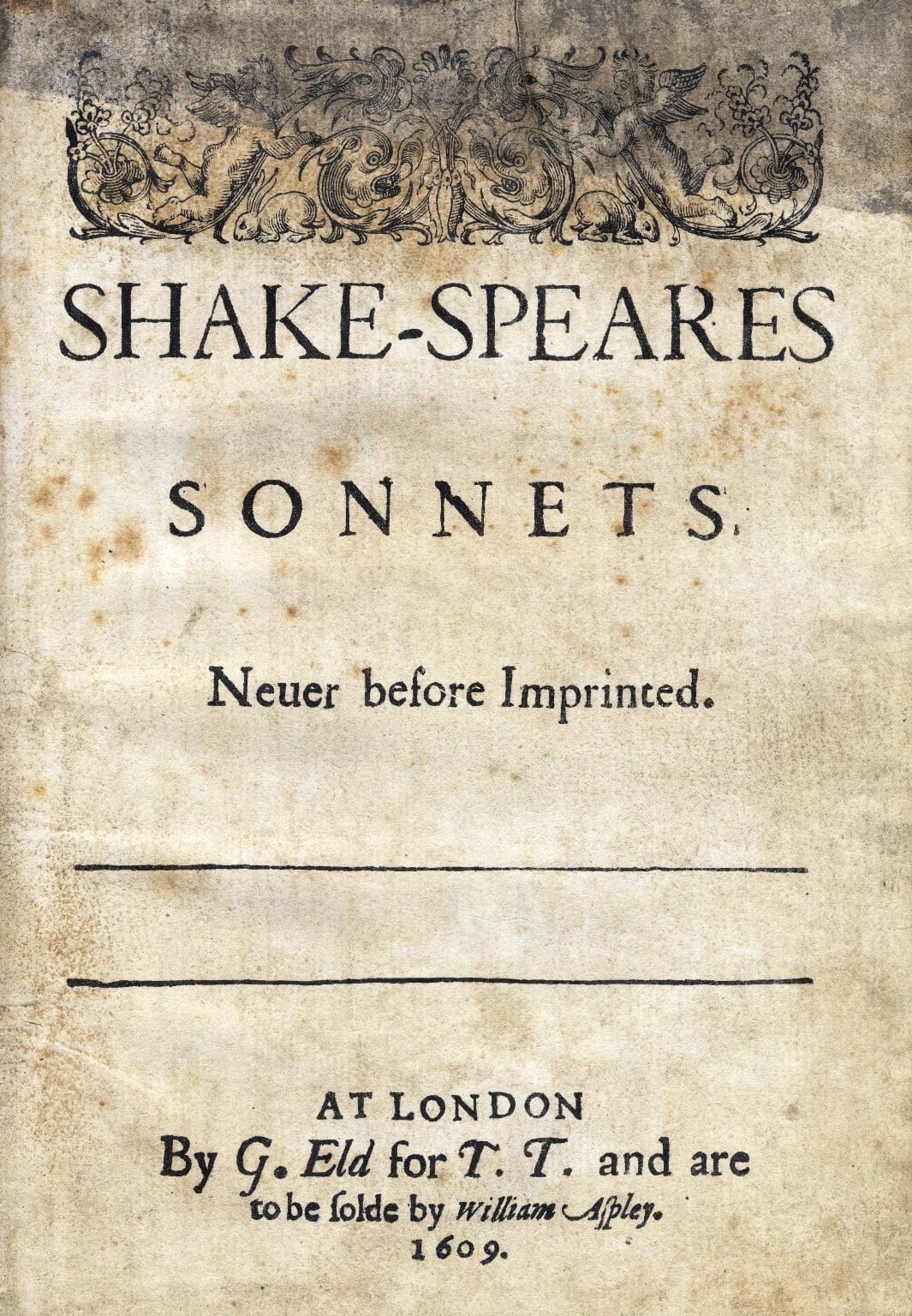
- Author / Source
- William Shakespeare (1564–1616)
- Period
- Elizabethan/Jacobean England; Sonnets published 1609
- Form & Meter
- Shakespearean sonnet sequence; three quatrains and a couplet
- Core Conflict
- Can love and verse survive betrayal, rivalry, and the certainty of death?
I. The Executive Dispatch (TL;DR)
- The middle sequence is about damage. The beloved has done something wrong; the speaker forgives, separates, and competes with a rival poet.
- The Rival Poet sonnets are less about the rival than about the speaker’s self-worth. The rival’s greater art becomes a way of measuring the speaker’s love.
- The time sonnets make poetry the last defence against oblivion. Marble, monuments, and waves all yield to verse — or so the speaker claims.
- The deathbed sonnets turn love into a problem of memory. The speaker wants to be remembered and wants to spare the beloved the pain of remembering.
- The one-line exam takeaway: the sequence’s middle movement tests whether love can survive betrayal and whether verse can survive time.
II. Historical & Intellectual Context (“The Backstory”)
The 1609 sequence and its middle movement
Sonnets 33–87 belong to the Fair Youth sequence, but they are darker and more narrative than the opening poems. The beloved is accused of a fault (33–36), the speaker competes with a rival poet (78–86), and the relationship moves toward separation (87). The sequence does not give a continuous story, but it creates a powerful sense of emotional development.
The middle sonnets also contain some of Shakespeare’s most famous meditations on time: 55 (“Not marble, nor the gilded monuments”), 60 (“Like as the waves”), 64 (“When I have seen by Time’s fell hand”), and 65 (“Since brass, nor stone”). These poems are often read as the sequence’s central statement about poetry and mortality.
The Rival Poet
Sonnets 78–86 introduce a rival poet who is praised by the Fair Youth and whose verse the speaker envies. The rival’s identity is unknown. Scholars have proposed Christopher Marlowe, George Chapman, Ben Jonson, and others, but the evidence is speculative. The sonnets are more interested in the psychology of rivalry than in historical identification.
The rival poet sequence is also about patronage and literary competition. The speaker fears that his own verse is inferior and that the beloved prefers the rival’s praise. The poems turn that fear into a defense of love over art.
The deathbed sonnets
Sonnets 71–74 imagine the speaker’s death. They ask the beloved to forget him, or to remember him only through the poem. The poems are both tender and manipulative: they use the prospect of death to secure the beloved’s attention.
III. Structural & Formal Architecture
The sonnet sequence as emotional argument
The middle sonnets are not a plot; they are a series of arguments. The speaker tries out different explanations for the beloved’s behavior, different consolations for time, and different ways of imagining his own death. The sequence’s power comes from repetition and variation.
The couplet’s turn
In these sonnets, the couplet often delivers a reversal or a concession. Sonnet 33 ends by accepting that “suns of the world may stain”; Sonnet 35 ends by admitting the speaker’s complicity; Sonnet 55 ends by imagining the beloved living “in lovers’ eyes.” The couplet is a place of summary, but also of unease.
Time and monument
The time sonnets use the language of architecture, geology, and war. Marble, brass, stone, and monuments are set against “this powerful rhyme.” The poem’s claim is audacious: verse is more durable than matter. The claim is also fragile, because the poem depends on readers.
IV. The Chronicle: Sonnet-by-Sonnet
Sonnet 33 — “Full many a glorious morning have I seen”
The Argument. The speaker compares the beloved to a beautiful morning that is suddenly obscured by clouds. The sun was “but one hour mine”; the cloud has masked it. Yet the speaker refuses to disdain him, because even the sun can be stained.
Key Evidence. “Full many a glorious morning have I seen / Flatter the mountain tops with sovereign eye” (33.1–2). “Suns of the world may stain when heaven’s sun staineth” (33.14).
The Subtext. The sonnet naturalises betrayal: the beloved’s fault is like a cloud passing over the sun. The analogy makes the fault easier to forgive, but it also makes it inevitable.
Sonnet 35 — “No more be griev’d at that which thou hast done”
The Argument. The speaker tells the beloved to stop grieving over his fault. Roses have thorns, fountains have mud, and the sun is stained by eclipses. The speaker then admits that he is complicit: he excuses the beloved’s sin and becomes “an accessary” to it.
Key Evidence. “No more be griev’d at that which thou hast done: / Roses have thorns, and silver fountains mud” (35.1–2). “Such civil war is in my love and hate” (35.12).
The Subtext. The sonnet turns forgiveness into self-corruption. The speaker’s love makes him an advocate for the beloved against his own judgment.
Sonnet 36 — “Let me confess that we two must be twain”
The Argument. The speaker accepts that he and the beloved must be separated, even though their loves are one. He will bear the “blots” alone and will not publicly acknowledge the beloved, to spare him shame.
Key Evidence. “Let me confess that we two must be twain, / Although our undivided loves are one” (36.1–2). “I may not evermore acknowledge thee” (36.9).
The Subtext. The sonnet makes separation an act of love. It also makes love a secret, and secrecy gives the relationship a dangerous intimacy.
Sonnet 55 — “Not marble, nor the gilded monuments”
The Argument. The speaker claims that his “powerful rhyme” will outlive marble and gold. War and fire may destroy statues, but the beloved’s memory will survive in the poem.
Key Evidence. “Not marble, nor the gilded monuments / Of princes, shall outlive this powerful rhyme” (55.1–2). “You live in this, and dwell in lovers’ eyes” (55.14).
The Subtext. The poem is a monument that claims to be better than monuments. Its confidence is magnificent, but it depends on the poem being read — and on “lovers’ eyes” to keep it alive.
Sonnet 60 — “Like as the waves make towards the pebbled shore”
The Argument. The speaker compares human life to waves advancing on a shore. Time gives and takes, crowns and confounds. Yet the poem will stand, praising the beloved’s worth.
Key Evidence. “Like as the waves make towards the pebbled shore, / So do our minutes hasten to their end” (60.1–2). “And yet to times in hope, my verse shall stand” (60.13).
The Subtext. The wave simile is one of Shakespeare’s most perfect images of sequential time. The poem’s counter-claim is not that time stops, but that verse can endure within it.
Sonnet 64 — “When I have seen by Time’s fell hand defac’d”
The Argument. The speaker catalogues ruins: buried monuments, demolished towers, the ocean eating the shore. Ruin teaches him that Time will take his love away. The thought is a kind of death.
Key Evidence. “When I have seen by Time’s fell hand defac’d / The rich-proud cost of outworn buried age” (64.1–2). “That Time will come and take my love away” (64.12).
The Subtext. The sonnet is unusual because it does not offer a clear consolation. The poem ends in grief, not in a triumphant claim about verse.
Sonnet 65 — “Since brass, nor stone, nor earth, nor boundless sea”
The Argument. The speaker asks how beauty can survive when even brass, stone, earth, and sea are subject to mortality. The only answer is a “miracle”: that his love may “still shine bright” in black ink.
Key Evidence. “Since brass, nor stone, nor earth, nor boundless sea, / But sad mortality o’ersways their power” (65.1–2). “That in black ink my love may still shine bright” (65.14).
The Subtext. The couplet names the poem’s medium — black ink — as the source of its miracle. The modest materiality of ink contrasts with the grandeur of the claims.
Sonnet 71 — “No longer mourn for me when I am dead”
The Argument. The speaker asks the beloved not to mourn for him after he dies. He would rather be forgotten than cause pain. The final couplet fears the world’s mockery.
Key Evidence. “No longer mourn for me when I am dead / Than you shall hear the surly sullen bell” (71.1–2). “Lest the wise world should look into your moan, / And mock you with me after I am gone” (71.13–14).
The Subtext. The poem’s request to be forgotten is also a demand to be remembered. It stages the speaker’s death as a way of testing the beloved’s love.
Sonnet 73 — “That time of year thou mayst in me behold”
The Argument. The speaker compares himself to late autumn, twilight, and a dying fire. Each image makes his age visible to the beloved, and each image intensifies the beloved’s love.
Key Evidence. “That time of year thou mayst in me behold / When yellow leaves, or none, or few, do hang” (73.1–2). “To love that well, which thou must leave ere long” (73.14).
The Subtext. The sonnet turns decay into an argument for love. The beloved should love the speaker more because he will soon be lost.
Sonnet 74 — “But be contented: when that fell arrest”
The Argument. The speaker imagines his death and distinguishes between body and spirit. The earth will have his body; the beloved will have his spirit, which remains in the poem.
Key Evidence. “But be contented: when that fell arrest / Without all bail shall carry me away” (74.1–2). “The earth can have but earth, which is his due; / My spirit is thine, the better part of me” (74.7–8).
The Subtext. The sonnet uses legal and financial language (“arrest,” “bail,” “interest”) to make death a transaction. Love is what survives the settlement.
Sonnet 80 — “O how I faint when I of you do write”
The Argument. The speaker compares himself to a “saucy bark” and the rival poet to a great ship. The rival’s verse is grander, but the speaker’s love is his own. If he is wrecked, it will be because his love has decayed.
Key Evidence. “O how I faint when I of you do write, / Knowing a better spirit doth use your name” (80.1–2). “My love was my decay” (80.14).
The Subtext. The sonnet is a defense of the speaker’s lesser art. It turns inferiority into a proof of sincerity.
Sonnet 87 — “Farewell! thou art too dear for my possessing”
The Argument. The speaker releases the beloved, saying that he is “too dear” to possess. The language of charters, bonds, and patents makes the relationship a legal transaction. The beloved’s worth is beyond the speaker’s deserving.
Key Evidence. “Farewell! thou art too dear for my possessing, / And like enough thou know’st thy estimate” (87.1–2). “Thus have I had thee, as a dream doth flatter, / In sleep a king, but waking no such matter” (87.13–14).
The Subtext. The sonnet turns farewell into a financial settlement. Its sadness lies in the gap between the dream of possession and the waking recognition of loss.
V. The Editorial Board: Deep Thematic & Critical Analysis
Betrayal and complicity. The “disgrace” sonnets do not simply blame the beloved. Sonnet 35 makes the speaker complicit in the fault by excusing it. The sequence is interested in the ways love compromises judgment.
Rivalry and self-worth. The Rival Poet sonnets turn literary competition into a meditation on worth. The speaker’s sense of inferiority is both painful and productive: it generates some of the sequence’s most searching poems.
Time, monument, and materiality. The time sonnets set verse against marble and brass. The claim that poetry outlives matter is a commonplace, but Shakespeare makes it feel precarious by insisting on the physical world’s resistance.
Death and memory. The deathbed sonnets ask what it means to be remembered. The speaker wants to control his memory, but he also fears that memory will become a burden or a joke.
The sequence’s unresolved story. The middle sonnets do not resolve the relationship. They move from betrayal to separation to farewell without a clear narrative closure. The sequence’s power lies in its incompletion.
VI. Exam & Essay Sparkplugs
1. “The Rival Poet sonnets are about poetry, not love.” Discuss.
Winning Thesis Blueprint. The Rival Poet sequence uses literary rivalry to explore the speaker’s self-worth and the value of his love. Poetry and love are not separable: the rival’s art threatens the speaker’s sense of himself as a lover.
Supporting points.
- The comparison of the speaker to a “saucy bark.”
- The rival’s “better spirit.”
- The defense of love over art in the couplets.
2. “Sonnet 55 is the sequence’s most confident poem and its most anxious.” Discuss.
Winning Thesis Blueprint. Sonnet 55 claims that verse outlives monuments, but its confidence depends on future readers and on the poem’s own survival. The poem’s anxiety is built into its boast.
Supporting points.
- The contrast between marble and rhyme.
- The image of war and fire.
- The final line’s dependence on “lovers’ eyes.”
3. “The deathbed sonnets are manipulative.” How far do you agree?
Winning Thesis Blueprint. Sonnets 71–74 use the prospect of death to secure the beloved’s attention and to control his memory. The manipulation is real, but it is also an expression of love and fear.
Supporting points.
- The request to be forgotten in Sonnet 71.
- The body/spirit distinction in Sonnet 74.
- The sequence’s recurring fear of being mocked or forgotten.